Showing posts with label 1980s. Show all posts

Thursday, October 20, 2016

The Strategery Behind Whitewashing

Tonight, the Packers will step on to the Lambeau Field turf wearing white jerseys for the first time since 1989. In that season, they wore their road jerseys for the first two games, against the Tampa Bay Buccaneers on September 10 and the following weekend against the New Orleans Saints.

This was the subject of a question posed to "Ask Vic" back in 2014 by "Mark from Fairfax, VA":
Vic, a few days ago while surfing YouTube for Packers videos, I came upon highlights of the 1989 Packers season when they were QB’d by Don Majkowski, went 10-6 but didn't make the playoffs. In one of their home games against the New Orleans Saints played at Lambeau Field, the Packers wore their white road jerseys. Might you know why that was done? And why did Green Bay play Dallas, an NFC East team, in that regular season twice? I’ve posed these questions on a couple of Packers sites but no one has answered.

(Packers.com senior writer Mike Spofford): Your question intrigued me, so team historian Cliff Christl and I put our heads together and did a little research. Turns out the Packers wore their white jerseys at Lambeau for each of the first two games in ’89, against the Buccaneers and Saints, and haven’t since. Cliff found a Press-Gazette article in which head coach Lindy Infante said it was planned in advance to beat the potential early-season heat by keeping the Packers out of their dark green jerseys. There was also talk of Tampa Bay QB Vinny Testaverde’s color-blindness, and his difficulty distinguishing reddish colors against green grass. The Bucs had switched before the ’89 season from wearing their orange jerseys at home to wearing white, but they were forced to wear the orange at Lambeau. The following week, the Saints wore their supposedly heat-absorbing black.

As it happened, the game-time temps were only 66 and 71 degrees, respectively, for those two games. Testaverde had a solid day, going 22-of-27 for 205 yards with one TD and no interceptions in beating the Packers, 23-21. The black-clad Saints may indeed have worn down, though, as the Packers rallied from a 21-0 deficit for a 35-34 victory, one of the biggest comebacks in team history.
So the results were mixed. Let's start with the first game, against the Bucs.

PewterReport.com

If the Packers were hoping to confuse Testaverde in that first game, it didn't work. But how awesome is it today to see those Creamsicle uniforms?

As Spofford mentioned, the Pack had more luck in the second game. Here's a view of the teams at midfield:


What's up with that gold "G" on the 50-yard line?

I always like seeing the classic single-gray-bar helmet graphic. The Packers continued to use it for years after the facemasks were changed to green. Here we see the graphic in the endzone:


Some things are constant, though; the gold railings at Lambeau Field are iconic.


Again, if the Packers had intended to place the Saints at a competitive disadvantage by making them wear black jerseys, they were unsuccessful. Mother Nature apparently didn't get the playbook, and the temperature at kickoff was very mild and clement. The Packers clawed back from that early deficit to win, but the white jerseys didn't help them.

And with those mixed results, the grand experiment was over and the Packers went back to wearing their dark jerseys at Lambeau Field. Until tonight.

Thursday, November 19, 2015

Packers in White at Lambeau Field?

It's become somewhat fashionable for NFL teams to wear white at home, especially during the first few months of a season. Only the Seahawks have never done it. Even our Pack has brought out the road whites before a hometown crowd, first in the 1930s, but also more recently than that.

The Packers have worn white at Lambeau Field twice; the first two games of the 1989 season. Here are some highlights from the Week 2 game against the Saints, as quarterback Don Majkowski tries to rally his Packers back from a 21-0 deficit at the end of the first half.


The Packers wearing road jerseys in Green Bay? It just looks wrong.


As wrong as that gold "G" on the 50-yard line.


I do like the classic single-bar helmet graphic in the endzone, though.


The Majik Man did rally his troops, and the Packers prevailed that day 35-34.

I don't know what possessed head coach Lindy Infante to mess with the classic. Fortunately, he came to his senses and returned to the classic green home uniforms.


UPDATE 10/20/2016: We've learned a little bit more about Infante's decision: the story is here.

Thursday, October 8, 2015

Lindy Infante Dies at 75

Packers.com

The Packers have announced that former head coach Lindy Infante, who guided the Pack from 1988-91, has died at the age of 75.

From his New York Times obituary:
Lindy Infante, who was named the N.F.L.’s coach of the year in 1989 when he revived the fortunes of the Green Bay Packers, and who later coached the Indianapolis Colts to the playoffs, died on Thursday in St. Augustine, Fla. He was 75.

The Packers announced his death on their website. LeRoy Butler, a Pro Bowl safety for the Packers who had played for Infante and spoke with his wife, Stephanie, told The Milwaukee Journal Sentinel that the cause was pneumonia.

Coaching the Packers from 1988 to 1991 and the Colts in 1996 and ’97, Infante had only one playoff squad: his first Colts team, which lost to the Pittsburgh Steelers in a wild-card game. His overall record was 36-60, but he was the victim of bad timing, losing both his head-coaching jobs in the seasons before his teams obtained two of pro football’s greatest quarterbacks.

Infante was fired by the Packers after they went 4-12 in 1991. The next season, they obtained Brett Favre in a deal with the Atlanta Falcons. Infante was fired by the Colts after they went 3-13 in 1997, although they had achieved a major upset with a 41-38 victory over the Packers, the defending Super Bowl champions and eventual National Football Conference champions. The Colts drafted Peyton Manning in 1998.

Gelindo Infante was born on March 27, 1940, in Miami. He was a running back at the University of Florida for three seasons and then an assistant coach with Florida, Memphis State and Tulane before coaching the Giants’ wide receivers in 1977 and ’78.

He was the offensive coordinator for the Cincinnati Bengals team that went to Super Bowl XVI on Jan. 24, 1982, losing to the San Francisco 49ers, 26-21. He was head coach of the Jacksonville Bulls of the United States Football League for two seasons, and then spent two seasons as offensive coordinator of the Cleveland Browns before getting the Packers’ head-coaching post, taking over what had been a losing team under Forrest Gregg, a star Green Bay offensive tackle in the Vince Lombardi dynasty years.

Infante’s first Packers team won only four games, but his 1989 squad went 10-6. Although the Packers did not reach the postseason, The Associated Press’s poll voted him coach of the year.

But two losing seasons followed, resulting in his ouster.

Infante’s 1996 Colts playoff team went 9-7, but Indianapolis was 3-13 the next year, and he was fired once more.

In addition to his wife, Infante had two sons and six grandchildren, The Florida Times-Union reported. A full list of survivors was not immediately available.

“I kiddingly call myself the ‘before coach,’ ” Infante told The Times-Union. “I was at Green Bay until one year before they got Brett Favre, and at Indianapolis one year before they drafted Peyton Manning.”

If he had either one of them, he said, “my career might have taken on 15 more years.”
It's easy to forget that era in Packers history. He was preceded as head coach by high-profile former players Bart Starr and Forrest Gregg, and replaced with Mike Holmgren.


I personally have fond memories of those years, especially quarterback Don "Majik Man" Majkowski. The æsthetics of the era have largely faded away like the silkscreen numbers on their jerseys, but as I review photos of him now I'm struck by the mesh trucker's cap he is often pictured wearing. The simple (even generic) "Breen Bay block over large "Packers" script was a commonplace style in the 1980s, and I'm strangely nostalgic for it today.

Farewell, Coach. Thanks for everything.

Friday, August 21, 2015

See the New Green Bay Packers Hall of Fame

Packers.com

This morning, the revamped Packers Hall of Fame opened to the public, and we're seeing some great views of what's in store for visitors to Lambeau Field.

The new museum displays are very impressive.

Packers.com

Gone are the old plaques; each inductee is now represented by a sculpture of a football.

Packers.com

It's a stunning representation, even more impressive close up. Each football is engraved with the inductee's name, picture, years with the team and year of induction.

Packers.com

Jeff Ash of the Green Bay Press-Gazette has suggested that these football sculptures would make excellent souvenirs if the Hall of Fame should ever sell them.

Packers.com

I think he's on to something there.

The reminds me a little of the Pro Football Hall of Fame in Canton, which ditched its plaques about ten years ago in favor of staggered rows of busts. Using footballs, however, emphasizes the team nature of the game. From a distance, it's all a unified whole. Only when you get close can you see the individuals comprising the team.

Of course, there's a lot for uniform fans to like. This is the new locker room section:

Packers.com
How could they get these reproductions so right and yet the new 2015 on-field alternate uniforms so wrong?

Of course, it's not all reproductions. The authentic Don Hutson jersey is still on display:

© Jeff Ash, used with permission

I think my favorite area has to be this overhead display of Packers uniforms, arranged in a chronological timeline:

© Jeff Ash, used with permission

As you move from right to left, the figures appear to be throwing a pass, and you advance through the highlights of the team's uniform history from the earliest days to modern times:

© Jeff Ash, used with permission

I'm a little jealous; the effect is one I was planning to use for a lithograph to celebrate the team's Centennial in a couple years.

© Jeff Ash, used with permission

There are two items of note I see in this tableau, which we'll address in separate posts.

Overall, the new Hall looks outstanding. Can't wait for my next trip to Lambeau Field.

Friday, April 17, 2015

R.I.P. Lee Remmel, Packers Historian

Sad news out of Titletown; Lee Remmel, who has been associated with the Packers since the Curly Lambeau days, has passed away at the age of 90.

Remmel was a true icon in a sport which tends to over-use the word. He started covering Packers games for the Green Bay Press-Gazette in 1945.

Reporters wait while the Packers’ board of directors meets for four hours in the Brown County Courthouse in Green Bay on Nov. 30, 1949, deliberating the fate of coach and general manager Curly Lambeau. From left are Lee Remmel, Art Daley and Dave Yuenger of the Green Bay Press-Gazette; Packers publicity director George Strickler, Don Arthur of radio station WDUZ, Bob Savage of radio station WBAY and Earl Gillespie of WJPG, the Press-Gazette’s radio station. (Press-Gazette Media archives)
For nearly thirty years, he reported on the ins and outs of the team, and when he finally left his beat in 1974, it was to join the Packers as their public relations director. Remmel's second career was as long and illustrious as his first, through the lean years of the 1970s and 1980s and finally renewed glory days that continue today. In February 2004, he was named team historian. Aided with an uncanny memory and a true gift for personal stories, he has done as much to educate modern football fans as anyone in the sport.

Lee Remmel stands next to the plaque erected in the Lambeau Field press box after it was named for him in August 2003. (Green Bay Packers archives)
The Press-Gazette has a wonderful gallery of Remmel's life. Of course, there are a few uniform gems in the gallery, including these two glimpses of 1950s uniforms. This period has been almost forgotten, lost between Curly's famous gold-yoked jerseys and the world-famous Lombardi design that endures (with a few tweaks) to this very day.

Packers fullback Fred Cone walks past Press-Gazette sports writer Lee Remmel, left, on the sideline at old City Stadium during the Packers’ 37-14 victory over the Baltimore Colts on Oct. 18, 1953. (Press-Gazette Media archives)
Press-Gazette sports writer Lee Remmel kneels along the sideline during the Packers’ 17-13 victory over the New York Giants in a preseason game at old City Stadium on Aug. 25, 1956. He’s flanked by Packers coach Lisle Blackbourn, left, and end Gary Knafelc. (Press-Gazette Media archives)
It's fascinating to watch the evolution of his career, as he starts out covering the players for the paper and transitions into working with them to manage that paper's coverage.

Press-Gazette sports writer Lee Remmel interviews Packers quarterback Bart Starr after Green Bay’s 13-10 victory over the Baltimore Colts in overtime in the Western Division championship game at Lambeau Field on Dec. 26, 1965. (Press-Gazette Media archives)
He flips from one side of the notebook to the other, but maintains the same intense look on his face.

Packers director of public relations Lee Remmel, second from right, stands between Press-Gazette sports writer Cliff Christl and Packers coach Bart Starr during an interview during the 1979 season. (Press-Gazette Media archives)
I love this look at a Lindy Infante's press conference, partly for the peek at 1989's sideline gear but also the guy next to Remmel wearing a Bucks jacket; you're more likely to find Packer apparel inserted in the background of unrelated sporting events than the other way around.

Lee Remmel, the Packers' director of public relations, stands at second from right as coach Lindy Infante meets the media during the 1989 season. (Press-Gazette Media archives)
For generations, Remmel has been a living link to the club's history. For people of my generation, it was to Lambeau and Lombardi. To younger fans, he was an official witness to those long-ago glory days of White and Favre.

Lee Remmel enjoys a laugh with Packers quarterback Brett Favre in the team's locker room during the mid-1990s. (Press-Gazette Media archives)
The Packers have created a tribute page to Remmel on their site with links to press releases and galleries covering his career (with an emphasis on his most recent recognitions). It's well worth a read.

Longtime Packers public relations man and historian and former Press-Gazette sports writer Lee Remmel talks about his life with the Packers at his home on Feb. 10, 2009. (Press-Gazette Media archives)
It is perhaps inevitable that loss seems to stalk any team with the long history of the Packers, as every year we lose one more human connection to that glorious past. I've long enjoyed reading Remmel's reminisces on that history, and we are the poorer now for his voice being silenced. R.I.P., Mr. Remmel.

Friday, November 8, 2013

Auction Gold from Heritage

Heritage Auctions has a fantastic auction ending this weekend, inclding some amazing Packers artifacts.

First and foremost is this incredibly rare, game-worn 1940s helmet, worn by Packer Hall of Famer Charley Brock.

From the second era of Glory Days, this flag flew over Lambeau Field in the 1960s:

The 1962 Packer squad is widely regarded as one of the best teams in sports history, let alone the NFL. This ball was signed by the entire squad:

Turning to sideline gear, Mary Jane Sorgel occupies a unique place in Packer history. During the Vince Lombardi era, she was the Lumberjack Band's majorette and romantically involved with team founder and former coach Curly Lambeau. This is the outfit she wore as the "Golden Girl" in those days:

There's something from every era in Green Bay's glorious gridiron history. I love this 1989-90 Tony Mandarich game-worn jersey, one of the last before the NFL added its logo to the collar:

I'm also partial to this 1980s helmet worn by Hall of Famer Jan Stenerud. Single-bar facemask cool! It's signed by Stenerud and others such as Bart Starr, Paul Hornung and Ray Nitschke.

This lot of ticket and two buttons from the first Super Bowl at the LA Coliseum show us that the nickname "Super Bowl" was applied to the game from the start, even if it didn't become official for a couple years:

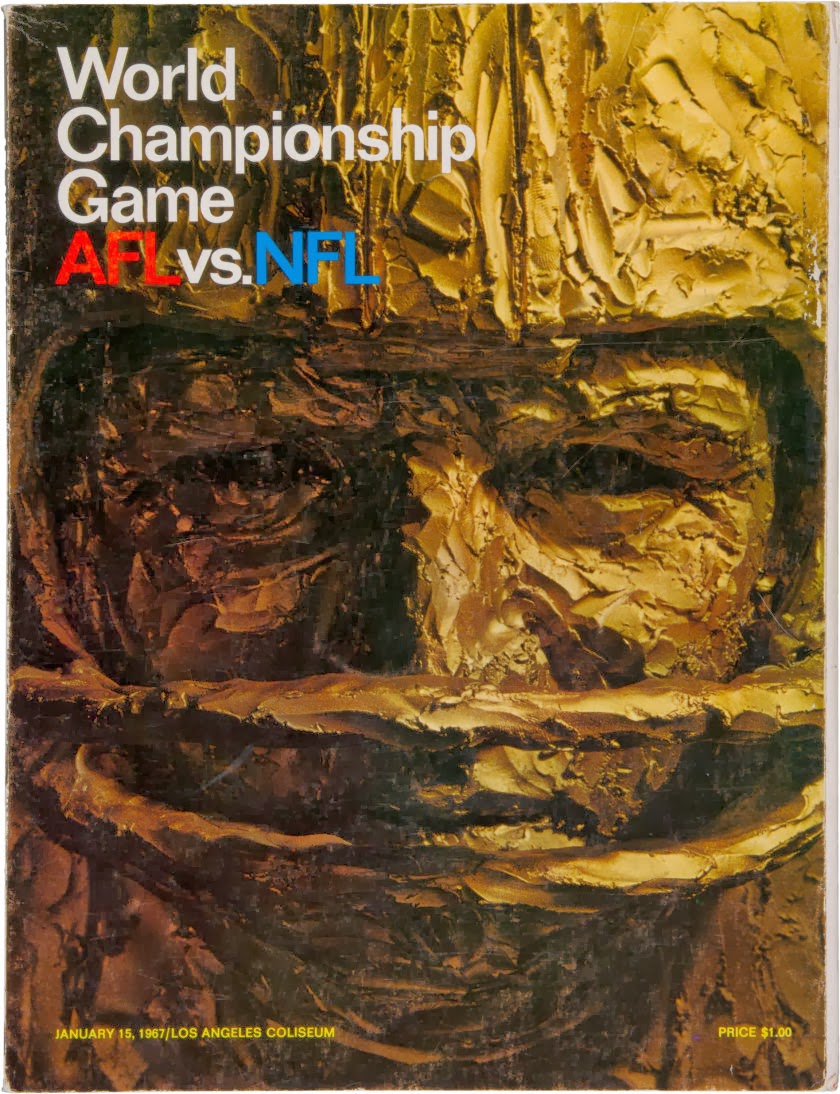
They also have programs from many championship games - the 1962 World Championship against the Giants in Yankee Stadium, 1965 World Championship Game against Cleveland at Lambeau Field, the 1966 NFL Championship in Dallas and the Ice Bowl, as well as Super Bowls I and II.


This just scratches the surface of Heritage's amazing offerings - check out the whole assortment here. Bid early, bid often!

Tuesday, April 23, 2013

1983 Draft Room

ESPN just tweeted out this photo of the NFL's Draft Room in 1983:

A far cry from the Rockefeller Center event I attended a couple years ago.

I love the helmet graphics marking each team's table. There's the Packers' table at the bottom of the shot:

That appears to be a gray facemask on the Packers sign, although the team changed to green for the 1980 season.

Thursday, March 14, 2013

Photo Gallery - Dr. Eugene Brusky

Green Bay Press-Gazette Assistant online editor Jeff Ash brings us a marvelous photo gallery of team physician Dr. Eugene Brusky, who passed away last week.

Brusky was hired by Vince Lombardi in 1962 and served the club until 1990. He had been inducted into the Packers Hall of Fame three years earlier.

Brusky was apparently known as "Dr. B"; at least, that was chainstiched on the watch cap he wore on the sidelines.

Dr. Eugene Brusky, the Green Bay Packers' team physician, in an undated photo. Vernon and Jim Biever photo
Brusky was on the sidelines for one of the Packers' dynasties, the greatest single decade any team has had in the NFL.

Dr. Eugene Brusky, the Green Bay Packers' team physician, works with quarterback Bart Starr in this undated photo. Green Bay Packers photo
Note the 1966 World Championship ring on the doctor's finger. He also saw the team through some less-than-glamorous times:

Dr. Eugene Brusky, the Green Bay Packers' team physician, examines quarterback Lynn Dickey during a game in the mid-1980s. Vernon and Jim Biever photo
Lynn Dickey's uniform helps us narrow down the date for that particular photo, at least to a three-year period; numbers on the pants were introduced as part of head coach Forrest Gregg's general re-design for 1984 and eliminated after the 1987 season. Dickey himself retired after 1985, which leaves us with a two-year window.

Brusky appears to be wearing the same outfit in this photo with quarterback Randy Wright, who wore the green and gold from 1984-88. If the two photos are from the same season, that would make it 1984.

Dr. Eugene Brusky, the Green Bay Packers' team physician, left, helps quarterback Randy Wright from the field in this photo from the 1980s. Packers trainer Dominic Gentile is at right. Green Bay Packers photo
In warmer weather, it would seem that Dr. Brusky spent much of his time on the sidelines in a gold sport shirt, either on its own:

Dr. Eugene Brusky, the Green Bay Packers' team physician, left, talks to linebacker Mike Hunt in this undated photo. Vernon and Jim Biever photo
or under a green jacket:

Dr. Eugene Brusky, left, the Green Bay Packers' team physician, talks with injured linebacker John Anderson during a game at Milwaukee County Stadium in an undated photo. Vernon and Jim Biever photo
In this photo, the gold shirt is paired with a mesh-back gold cap.

Dr. Eugene Brusky, center, the Green Bay Packers team physician, looks at medical supplies on the sideline before a game at Milwaukee County Stadium in this undated photo. Packers trainer Dominic Gentile is at left. Vernon and Jim Biever photo
I love the helmet graphic on those caps, with its single-bar gray facemask. The Packers switched to green facemasks in 1980, but continued to use a gray-masked logo as late as 1993.

When Dr. B retired after the 1990 season, the Packers presented him with a bronze medical bag.

Dr. Eugene Brusky is honored for his 29 years of service as the Green Bay Packers' team physician before the game between the Packers and the Detroit Lions at Lambeau Field on Dec. 15, 1991. Press-Gazette Media archives
There's the "Dr. B" cap again.

The full gallery is here. Once again, the Press-Gazette illuminates a chapter in the Packers' history that could easily have gone ignored.