Monday, February 25, 2013

Auction Gold - Curly Lambeau's Cleats

This one's a doozy.

MEARS is offering a once-in-a-lifetime find in their current auction; a pair of football cleats worn by Curly Lambeau.

The catalog description is extensive, so I'm going to reprint it here in full for its historical value.

Lot #360: 1929-43 Earl "Curly" Lambeau Green Bay Packers Game Worn Riddell Yellow Back Kangaroo Leather Football Cleats (MEARS/Consignor LOA)


The Heart and Sole of Green Bay

Curly Lambeau was the heart and soul of the Green Bay Packers. Without him, there would be no team in Green Bay today. Other early small town franchises such as Akron and Rock Island lasted only a very short time before fading into football obscurity. Lambeau, through relentless determination saved Green Bay from a similar fate.

Offered for the MEARS Online Auctions current sale is a rare game worn item of great historical importance associated with Green Bay Packers' legend, Curly Lambeau. In a recent interview with Tom Murphy, Green Bay Packers Hall of Fame Archivist, he stated he was unaware of any personally worn item belonging to Curly Lambeau in the archives of the Packers Hall of Fame.

The staff of MEARS Auctions also combed auction catalogs, past sales records, and internet archives and was not able to find one single Curly Lambeau game worn item to come to public market. This means that to my knowledge and the very best of my research abilities, this is the first and only Curly Lambeau game worn item to survive which can be linked to his possible playing days and coaching career. Research also dates this item exclusively to Lambeau's tenure with the Green Bay Packers, 1929-43 circa.

World class collections must contain an anchor piece, an item that represents the genesis of a player or franchise. Each main sports category has a nucleus, an item that is the origin of the sport and represents a greater meaning than the artifact itself.

Our hobby has seen several items that fit this classification. Examples that come to mind are the 1869 Cincinnati Red Stockings trade card which is the foundation of a great baseball card collection or the 1891 James Naismith Basketball Rules which outlined the birth of professional basketball.
For this lot, we are offering Curly Lambeau's 1929-43 circa Green Bay Packers personally worn football cleats, originally given as a gift to close personal friend Mary Jane Duyse. As Lambeau proudly carried the Packers franchise on his back, he was wearing these shoes on his feet. These shoes epitomize the importance of Curly Lambeau to the Green Bay Packers and the NFL. This is one of the most icon relics of Green Bay Packers history ever to be offered publicly.

Mary Jane Duyse
Mary Jane Duyse was with Curly Lambeau during his final moments. According to the book, "Lambeau: The Man Behind the Mystique" by David Zimmerman, copyright 2003, the author chronicled Curly Lambeau's final hours while preparing for a date with the much younger Mary Jane. He wrote,
"He drove slowly through Egg Harbor, another little Door County town. He thought of Mary Jane and how much he enjoyed being with her. Even though she was half his age, it didn't seem to matter to the two of them.

Mary Jane, still living at home, waited as her father Francis mowed the grass of the front yard with an old push mower. "Hey Francis, let me take a turn at that. I need some exercise," said Curly. Up and down the lawn he went. It felt good. He felt good. "Look at the new dance I've learned in California," and began to do the twist. Francis yelled, "Don't do this!"

With sweat rolling down his face and his shirt now damp with perspiration, he stopped, reached for his handkerchief in his back pocket and began wiping his face. Suddenly, he felt dizzy, disoriented and sick to his stomach. "I feel kind of sick," he mumbled, and then fell backwards into Francis' arms."
Curly Lambeau died on the front lawn at 522 Michigan Street, Sturgeon Bay, WI, on June 1st, 1965. He was 67 years old.

Along with several letters, photographs, and other items of memorabilia, Curly Lambeau presented Mary Jane Duyse's family these game worn shoes. They proudly remained in her collection for many years before being gifted to her Sturgeon Bay neighbor.

Research conducted by MEARS Authentication services dates these shoes to the 1929-43 era, all exclusive to his tenure with the Green Bay Packers. This was determined by photographic analysis, review of trade ads, and a review of the physical shoe construction.

The shoes themselves were manufactured by Riddell Sporting Goods are an early version.

According to his online biography, John Tate Riddell was born in Georgetown, Michigan in October, 1885. From 1913 through 1927 he taught Mathematics and was Head Football Coach and Athletic Director at Evanston Township High School in Evanston, Illinois. It was at this time Mr. Riddell invented and developed the removable cleat.

He did it to solve a problem for his Evanston High School team. In those years football shoes were equipped with leather cleats. At the time, football cleats were made of leather and nailed to the sole of the shoe. Changing cleats due to inclement weather required the services of a cobbler to have longer "mud cleats" installed. Because Northwestern University used the same cobbler as Evanston Township High School, Evanston's football shoes were often not finished by game time.

Riddell knew his idea would solve this problem for everyone, once and for all. Lacking the capital necessary to start his own business, Riddell had his shoes manufactured by the J.P. Smith Shoe Company, and he and his wife installed the posts and cleats in the evenings. He continued to teach, coach and produce his shoes until 1927, when, with the popularity of shoes growing, he left education to devote his entire effort to producing shoes. John T. Riddell, Inc. was formed in February, 1929.

It makes great sense that Curly Lambeau would have quickly adopted the use of a new innovation such as a detachable cleat. Everything written about him supports his promotion of strategic innovation and it is only logical that translated to improvements in available equipment.

Dating 1929-43 circa

Since Riddell officially formed as a company in 1929, we base the starting date as a possible year of issuance to 1929. This was due to the fact "RIDDELL" is stamped in a series of punch holes on both tongues. It is possible based on the design these shoes were available to Lambeau to wear during his final season as a player/coach with the 1929 Packers team.

According to May, 1932 John T. Riddell, Inc. print ad (copy included), the cleats were described as, "Riddell Football shoes were first used in 1922, Northwestern University has used them continuously since 1923. University of Chicago since 1924, Illinois and Nebraska and many others since 1925. Riddell cleats have won for themselves the unique distinction of being the original and only screw cleat that will stand under hard usage."

Examination reveals this is the correct 7 screw cleat shoe offered by Riddell during the period.

Further review determines these cleats are the hand turned yellow back Kangaroo hide, consisted with catalog model, "Style G" which originally sold for $14.00 and was the top of the line model. The literature goes on to note that the several colleges including the University of Wisconsin wore this model shoe.

Examination of the cleats when compared to the Riddell official sales literature helps MEARS determine this is a No. 1 style cleat. The catalog describes it as, "No. 1, Best for practice and wear. Being softer is easier on the feet."

The catalog does list cleat No. 4 as a "game cleat". Since No. 1 was listed as "best for practice", this may indicate this was Lambeau's preferred pair of coaching shoes.

With the rudimentary application of the tongue "RIDDELL" stamping, his may have been personally done by John T. Riddell and his wife as they built the early cleats together during the evenings. This would pre-date our estimated 1929 dating and would have made these shoes available for Lambeau to wear while a player for the Green Bay Packers. This fact cannot be substantiated, but the strong possibility does exist. A 1927 image of Lambeau playing for the Packers feature him wearing a similar pair of high top football cleats, but the exact maker is unidentified.

Imagery Analysis of Lambeau Cleat Style

Available images verify Lambeau as wearing this style at various points of his career with the Green Bay Packers. The following images support high top cleats being worn by Lambeau early in his career, 1927-43, and low tops later:

1927 Lambeau throwing as player (Riddell attribution is not positive)

1932 Lambeau with high tops

1945 Lambeau with low tops during training camp

1948 Lambeau with low tops during practice

1950 Lambeau with low tops

1951 Lambeau with low tops

Available images suggest that Lambeau switched to a low top style around 1944, and continued with that preference until his retirement from Pro Football in 1952.

Physical Wear Description

Examination reveals both Riddell shoes have heavy game wear. The entire leather exteriors of the shoe shows scuffing and wear to the yellow Kangaroo hide. The canvas interior also shows signs of heavy game wear. Certainly a full season's worth of use, possible more. Both "RIDDELL & 11 (size)" are punched into the leather of the tongue. Both cleats have a complete set of (7) No. 1 style cleats that remain tightly attached. The left shoe has replacement black leather lacing, the right shoe has a vintage brown leather lace, and I am not sure if it is vintage to the shoe. Small clumps of ancient dried mud and grass are found embedded into various crevices of the sole's of the shoes, possibly picked up at City Stadium or Milwaukee State Fair Park.

Lambeau Identication and Attribution

In addition to the direct chain or provenance, each shoe is marked with an unique identifier exclusive to Curly Lambeau. On the left shoe, "C.L". I is neatly written in faded, worn black marker.
On the right shoe, "Curly" is neatly written in faded, worn black marker. The use of the name "Curly" is proper for the era as he was first listed as "Curly" Lambeau in a 1918 newspaper article covering his Notre Dame career. The name stuck and we was referred to as Curly almost ever since.
Examination reveals the black marker to be faded and worn, both signs of authentic patination. The remnants of the ink have set deeply in with the leather of the soles. It is in my expert opinion that the writing was placed on the shoes around 80+ years ago.

Provenance

These shoes have remained in Sturgeon Bay since the day Curly Lambeau personally hand delivered them to Mary Jane Duyse. The cleats were proudly displayed in her home for many years. At some point after the death of Mr. Lambeau, the next door neighbor of Mary Jane Duyse obtained the shoes from the Duyse family. He cherished them for many years before gifting them to our consignor (also a Sturgeon Bay resident) shortly before his death. I personally drove to Sturgeon Bay to take possession of the shoes for our current auction, which was only miles from the home of Mary Jane Duyse and the spot where Curly Lambeau died. The existences of the shoes have been known within the Packers collecting community for many years. Our consignors' letter will chronicle the names of all owners in the custody chain.

Historical Feats Accomplished During the Era these shoes would have been worn

During 1929 Lambeau became the team's coach and playing captain. Lambeau was the first pass-minded coach in the NFL and his teams were like their leader, impatient and explosive. An excellent passer in his own right, Curly flew in the face of common practice.

Despite rules that made it difficult to use the forward pass, Lambeau's Packers were a team whose main offensive weapon was the pass – at any time, on any down, from anywhere on the field. With his vaunted passing attack, he led the Packers to championships in 1929, 1930, and 1931. After signing future Hall of Fame receiver Don Hutson in 1935, they won three more titles – 1936, 1939, & 1944."

It is highly probably these shoes were worn during one or more early Championship season. A more historic item of Green Bay Packers history does not exist. It is our opinion that these cleats are the only known personally worn item that survived the career of Curly Lambeau. This lot represents a very rare opportunity to own the only known game worn artifact directly linked to football icon Curly Lambeau.

A LOA from the consignor detailing the provenance directly back to Mary Jane Duyse will accompanying this lot. LOA Troy R. Kinunen / MEARS Auctions, LOA consignor. LOA Troy Kinunen / MEARS
I'm usually very skeptical about an item like this, but this seems solid. I first heard about these cleats several years ago, but don't recall that provenance. Very exciting.

Shame that these cleats will likely disappear into a private collection; they really belong in the Packers Hall of Fame.


UPDATE 3/3/2013:   The final hammer price, including Buyers Premium, was $25,958. If this is to be the centerpiece of a private collection, I'd like to see the rest of that collection.

Saturday, February 23, 2013

1926 Team Blanket Donated to Hall of Fame

I don't know how I missed this from last August, but a 1926 team blanket was recently donated to the Green Bay Packers Hall of Fame.

Packers Hall of Fame Inc. announces donation of 1926 team blanket

The Green Bay Packers Hall of Fame Inc. today announced the donation of a 1926 Green Bay Packers team blanket by Bill Cahoon of Dandridge, Tenn.

The blanket, which belonged to Bill Cahoon’s father, Ivan "Tiny" Wells Cahoon, is square and about four feet across. It is light purple with gold lettering that reads “Green Bay” with the number "10" on it. According to the Hall of Fame, it's possible that the item was originally blue, but has faded to light purple over time.

"I didn't even realize this blanket existed," Bill Cahoon said. "My sister gave it to me. I asked her, 'Where did you get this?' and she said, 'Mom gave it to me!' It's an interesting piece of history and I doubt if there are any others like it. I want to donate it to the Packers Hall of Fame so that others can see it. The Hall of Fame is very well-known and a lot of people will be able to view the blanket there."

Ivan Cahoon played as an offensive and defensive tackle for the Packers from 1926 to 1929. Under coach Curly Lambeau, Cahoon played in 31 games, starting in 27. Cahoon’s football career ended during the 1929 season, just before the Packers' first NFL championship, when he sustained a knee injury.

After his retirement from football, Cahoon maintained his connection to the sport by coaching high school football. In 1933, he took up the reins at Green Bay West High School.

In 1938, Cahoon became the coach and athletic director at Monmouth College in Monmouth, Ill., a job set up for him, according to his son, Bill, by Packers teammate Jug Earp. He then left Monmouth after two years and went up to Milwaukee to coach a professional team, the Chiefs. Then World War II broke out. He also coached some service teams during his time in the Army.

During World War II, Cahoon was promoted from captain to major. He died at an Army hospital in San Francisco, Calif. on Feb. 3, 1973 at the age of 72. A graduate of Gonzaga University in Spokane, Wash., he was inducted into the Gonzaga Athletic Hall of Fame in 1991.

Although the origin of the blanket is unknown, it is likely that it was given to Cahoon after the Packers 7-3-3 season in 1926 as a year-end gift.

"We are very excited to receive this blanket," said Tom Murphy, Packers Hall of Fame Inc. director and archivist. "We don't have many items from that era, so we are very thankful for Bill’s donation."

This is not Bill Cahoon's first donation to the Hall of Fame. In 1966 he donated a football that was given to his dad after his only career touchdown during the Sept. 25, 1927, contest against the Cleveland Bulldogs. That ball can now be seen in the Johnny "Blood" McNally display at the Hall of Fame.
A great story, and what an incredible artifact.

1926 was the team's second season in City Stadium after leaving Hagemeister Park.

The 1926 Green Bay Packers

The team went 7-3-3 that year, which was good enough to earn fifth place in the single-table NFL.

W L T %
Frankford Yellow Jackets 14 1 2 .933
Chicago Bears 12 1 3 .923
Pottsville Maroons 10 2 2 .833
Kansas City Cowboys 8 3 0 .727
Green Bay Packers 7 3 3 .700
New York Giants 8 4 1 .667
Los Angeles Buccaneers 6 3 1 .667
Duluth Eskimos 6 5 3 .545
Buffalo Rangers 4 4 2 .500
Chicago Cardinals 5 6 1 .455
Providence Steam Roller 5 7 1 .417
Detroit Panthers 4 6 2 .400
Hartford Blues 3 7 0 .300
Brooklyn Lions 3 8 0 .273
Milwaukee Badgers 2 7 0 .222
Dayton Triangles 1 4 1 .200
Akron Indians 1 4 3 .200
Racine Tornadoes 1 4 0 .200
Columbus Tigers 1 6 0 .143
Canton Bulldogs 1 9 3 .100
Hammond Pros 0 4 0 .000
Louisville Colonels 0 4 0 .000

Ties didn't count in the standings in those days—if they had, the 1933 Packers would have won their fourth championship in a row, as their 10-3-1 record was judged inferior to the champion Bears' mark of 7-1-6.

What a time to be a football fan in Green Bay; Curly Lambeau was still at the height of his playing career, and the Packers were on the verge of putting together the dynasty that would win three consecutive championships. This blanket must have been present for some amazing games.

Tuesday, February 19, 2013

Exhibition Game in North Carolina, 1954

On September 11, 1954, the Packers faced off against the Washington Redskins in a pre-season exhibition game in Raleigh, North Carolina. Photos from that game give us another look at our club's 1954 uniforms.

Washington Redskin running back Charlie Justice evades a tackler after catching a pass for an eleven-yard gain against the Green Bay Packers at Riddick Stadium, Raleigh, N.C. on September 11, 1954.
In those days, Washington was the southernmost city in the NFL, and owner Preston Marshall considered the entire South as his territory. He drafted many players from southern schools, and he held exhibitions all over the region. This particular contest was a night game held at North Carolina State University, and featured his star halfback, Charlie "Choo Choo" Justice, a local boy and alumnus of UNC.

Washington Redskin running back Charlie Justice rushing along the left sideline
I don't recognize the Packer trying to chase down Justice; the Packers' website doesn't list #55 as having been issued in 1954, so it's someone who wasn't on the roster by the time the regular season rolled around.

Thursday, February 14, 2013

Good Riddance to Purple Rubbish

The Minnesota Vikings unveiled their new logo today.

Well, their enhanced logo, since the team insists it's not a logo change:
The Norseman has been the face of the Vikings franchise since the team’s inception in 1961, long exhibiting the history and tradition of the Vikings and our passionate fan base. That will not change. But beginning today, the Vikings have enhanced the team’s primary mark to give it a more natural and defined look.

Unveiled exclusively to Season Ticket Owners this morning, the sharper, bolder mark speaks to the direction the team is heading while still preserving the tradition of the Norseman. Fans will see from the side-by-side comparison that this is not a logo change. Rather, the enhancements simply give the mark an improved, more defined appearance.
The changes are subtle (I bet we'll continue to see the old logo in the media for years to come), none more so than the color. The Vikings, while keeping the same purple hue, are tweaking their gold to make it a little lighter. Guess they got tired of wearing the exact same shade of gold as the Packers.

Monday, February 11, 2013

Home Sweet Home - Hagemeister Park, 1923

Neville Public Museum
This picture was taken in Joannes Park, where the Green Bay Packers practiced in 1923, with the photographer facing northwest. Green Bay East High School was under construction at the time and the far west end of it is visible on the right. The homes to the left of the old Hagemeister Clubhouse at center were located on Walnut Street, just west of Baird Street.
Here are your 1923 Green Bay Packers, photographed in their gold jerseys with nine thin navy stripes on each sleeve, and billed as the "state and northwest champions".

Joannes Park still exists today.


View Larger Map

Behind the players, and at the very right edge of the photograph, you can see East High School's new building under construction. That construction included a new sports field, which would soon be known as City Stadium and, beginning in 1925, would become the new home of the Packers.

Tuesday, February 5, 2013

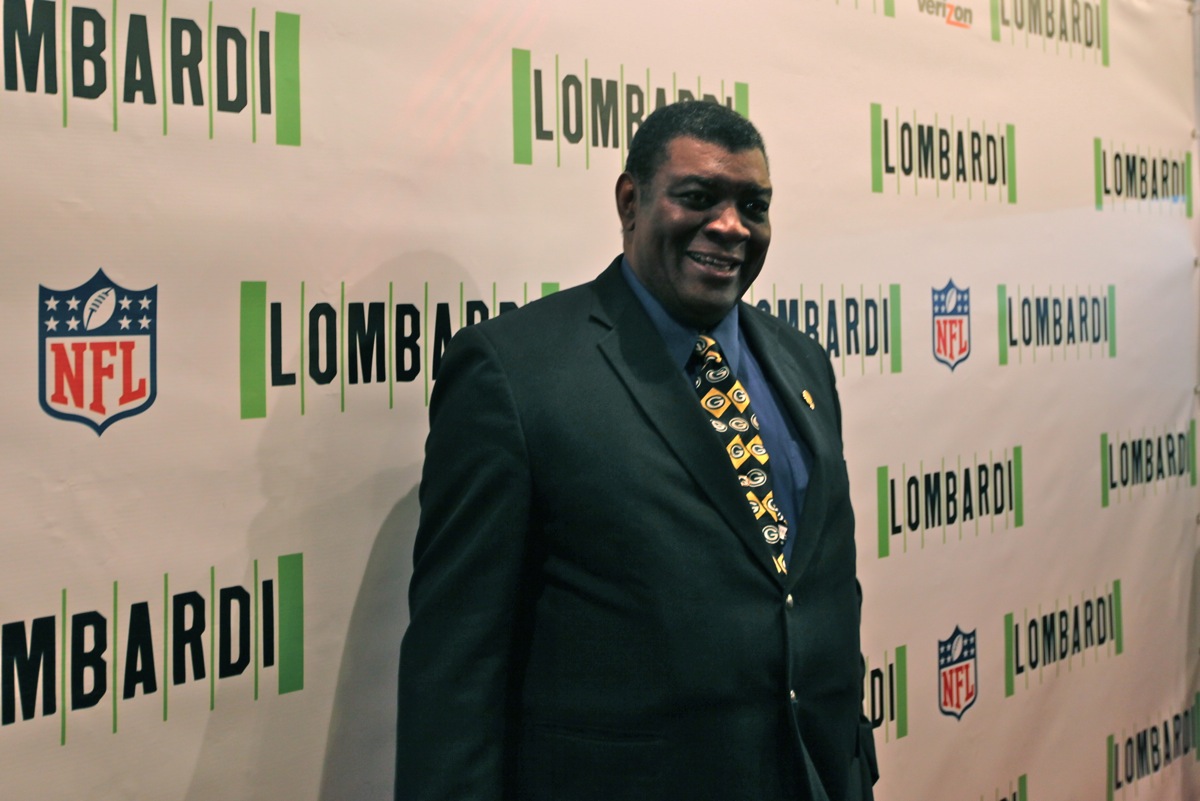
Dave Robinson, Class of 2013

One of the more exciting events to come out of Super Bowl week was the announcement that Packer linebacker Dave Robinson has been elected to the Hall of Fame in Canton, the 22nd Packer so honored.

Which is a great excuse to post some pictures of Lombardi's classic 1960s uniform, if we really needed one.

Robinson played ten seasons for the Packers (1963-72) before finishing up his career with two seasons in Washington. As a Packer, he was a three-time Pro Bowler, named first-team All-Pro two times and selected as part of the NFL's All-Decade Team of the 1960s.

Robinson's career in green and gold spanned into the 1970s, meaning he was among the first players to wear his name on the jersey. Names were added in 1970 as part of the merger agreement with the AFL.

Last year, Robinson published a book with Herb Adderly entitled Lombardi's Left Side. With Willie Davis, they anchored the left side of the defensive line during the glory days of the 1960s. Most quarterbacks of the era were right-handed, meaning that offenses were weighted towards the right for passing and running, and a defense's left side was with stopping them. Davis, Adderly and Robinson were perhaps the strongest defensive left side in NFL history, and with Robinson's selection, they are all enshrined in the Hall of Fame.

In 2010, Robinson was immortalized in a different way, as one of three Packer players represented in the Broadway play Lombardi, played by Robert Christopher Riley (far left):

Here he the man himself, attending the Broadway opening:

Congratulations, Mr. Robinson. An honor well-deserved.

Sunday, February 3, 2013

Call It in the Air

Another Super Bowl Sunday is upon us. The Packers are watching the game on television like the rest of us, so I thought it might be worthwhile to take a quick look back at an often-overlooked moment of that first NFL/AFL Championship Game; the coin toss at midfield:

Representing the Packers, we have defensive end Willie Davis and tackle Bob Skoronski shaking hands with their Kansas City counterparts. Interesting that they're both wearing their helmets while both Chiefs are carrying theirs.

That crown-on-a-football graphic is about the closest thing that game had to a logo.

How times have changed since that afternoon at the Los Angeles Memorial Coliseum on January 15, 1967. Not only the Big Game's logos, but the toss itself. Here's the coin flip from Super Bowl XLV:

Friday, February 1, 2013

Facebook's View of Packer Nation

An interesting experiment - Facebook has been analyzing their data to see what it can tell us about the nature of fanbases all across the country.
While winning seems to matter, NFL teams have local followings that are probably heavily influenced by family ties and/or where a person grew up, so we were obviously curious to see where the fans for various teams live now. By considering the physical locations of NFL fans, we can construct a map of the top team for each county in the US. It tells an interesting story about the ways that football rivalries and allegiances alternately divide and unite the country, and sometimes even individual states.
Here's what they came up with:


Interesting. All of Wisconsin is Packer Country, of course, and most of the Upper Peninsula, but so are scattered counties in Iowa, Nebraska, North Dakota, Montana, Iowa and Oregon. And then there's Alaska, where the relatively-local Seahawk areas are dwarfed by fans of the Steelers and Packers.

Tuesday, January 29, 2013

Auction Gold - Buford "Baby" Ray's 1948 Jersey and Jacket

A few weeks ago, I received an email from Leo Villasenor, a vintage clothing collector. He had found some interesting items in an antique shop:
I was shopping at an Antique mall here in Las Vegas and there was a small rack of really old clothing. I initially noticed the sweater because i thought it was an old motorcycle sweater. I read the packers and the size was a size that actually fit me. I noticed the Jersey as well and not knowing much about the Packers at the time, I assumed that the Packers colors had always been the green and yellow. I just figured either way it was cool item but i had no idea the 2 items belonged together because they were dated by the dealer 2 different time periods. In all honestly because I didn't see the green and yellow i didn't even think that there were Green Bay Packers items. I had assumed it might have been a college team or even a high school team.

The jersey had been dated earlier then 1950s by the gentlemen who was selling the items, because the label reads "O'Sheas Knitting Mills Oct. 10-1916 - April 8,1924." He had dated the sweater as 1940s, so I wasn't to sure what time period the jersey or the sweater was from.

I started to look at several websites and then i realized that these items were in fact Green Bay packers. I found some old pix from another site and even seen some auctions sites where similar items have been sold.

A friend of mine who also collects old clothing and even has a blog site helped cross reference sites. He suggested that I contact the Green Bay Packers to possibly get the items authenticated but I hit a brick wall there. It seems pretty impossible to get ahold of anyone at the organization.

I emailed you cause I seen your site was the most useful in finding out any info. Thanks again I really appreciate your help.
I wasn't terribly surprised that the Packers weren't able to help him; that's not really what they do. The team has made enough mistakes chronicling the broad outlines of its own history, much less detail work such as this (those mistakes were why I started this blog in the first place, which is a story for another day).

These were the photos Leo sent me:

I was floored. He got these in an antique mall in Las Vegas?

I recognized the sideline pullover instantly. I don't know when it was introduced, but the Packers were using it well into the 1950s.

The jersey looked to me like it could have been Curly Lambeau's last change to the Packers uniform, a solid navy jersey with gold numbers. The gold yoke, so emblematic of Lambeau's teams of the 1940s, had been removed to create a rather generic jersey, easily forgotten and easily ignored.

The tagging Leo described matched other Packer jerseys from the 1940s. The Packers bought their gear from O'Shea for many years during Lambeau's tenure.

It seemed to me that his find could well be genuine. At the very least, this required an expert. I referred Leo to MEARS, the Milwaukee-based authenticators and auctioneers. They must have been as pleased to see these as I was, because the jersey and jacket are featured in the current MEARS auction, now open through February 2nd, 2013, 9:00pm Central.

This is the jersey listing:
Lot #231: 1948 Buford "Baby" Ray Green Bay Packers Game Worn Home Jersey (MEARS A9) "First example discovered"

A free agent from Vanderbilt in 1938, Buford 'Baby' Ray was a dominating blocker and defensive tackle.

The co-captain of the Vanderbilt University Commodores in 1937, the 6'6" Ray was a giant of a lineman in his time. He weighed more than 280 pounds in college but dropped 30 pounds in his first season with the Green Bay Packers.

He blocked a punt for a safety against Detroit in 1939 in a game the Packers won 12-7. Ray played 11 seasons, from 1938-48. He was a member of two Packers championship teams. Ray became a long-time Packers scout after his retirement. For this auction, MEARS is proud to offer the first 1948 Green Bay Packers home jersey to ever enter the hobby. This is also less than approximately 6 surviving pre 1950 Packers jerseys known to have entered the hobby.

Supplied by rival city Chicago's King O'Shea, the jersey is manufactured from blue knitted wool. The body shell has full length set in sleeves with ribbed openings. The tail is complete with a 6 button crotch piece. The numerals, 44, appear on both front and back in serifed numbering. The numerals are yellow satin and serve as a bright contrast to the navy shell.

Size 44 appears in the crotch piece.

The jersey shows signs of heavy game wear. The shell fabric shows stress from contact. Numerous hit marks can be found on both the front and reverse numerals. The back of the jersey has about 12 small moth holes. They cannot be seen when displayed due to the navy color of the jersey, but are mentioned for accuracy and grading.

Final Grade (MEARS A9): Base grade of 10 points were assigned for jersey matching correct manufacturer, style, and sizing for Ray. 1 point was subtracted for the small holes on reverse. LOA Troy R. Kinunen / MEARS (B0238)
Here's the listing for the jacket:
Lot #226: 1948 Buford "Baby" Ray Green Bay Packers Game Worn Home Team Jacket (MEARS LOA) "First example discovered"

Offered is a matching jacket to the 1948 Buford Ray game worn jersey offered in this auction.

A free agent from Vanderbilt in 1938, Buford 'Baby' Ray was a dominating blocker and defensive tackle.

The co-captain of the Vanderbilt University Commodores in 1937, the 6’6” Ray was a giant of a lineman in his time. He weighed more than 280 pounds in college but dropped 30 pounds in his first season with the Green Bay Packers.

He blocked a punt for a safety against Detroit in 1939 in a game the Packers won 12-7. Ray played 11 seasons, from 1938-48. He was a member of two Packers championship teams. Ray became a long-time Packers scout after his retirement.

This is the first example of this style jacket that MEARS has evaluated.

Manufactured by Wilson (black tag with red lettering, 1948-55), this wool pull over jacket has full length sleeves which are trimmed in double stripe yellow trim. The collar has one single yellow stripe. "PACKERS" (3 ½") lettering appears in yellow cotton on the reverse. The jacket remains in excellent condition, with 12 moth holes on the reverse near the upper collar and 5 on the front. The holes are almost impossible to see due to the navy collar, but mentioned for the sake of accuracy.

Jacket shows heavy overall game wear, but still displays near mint. First example examined by MEARS. LOA Troy R. Kinunen / MEARS (B0237)
The description also includes this photo of Curly Lambeau and his men on the sidelines (it doesn't say whether this photo is included in the auction).

Bid early, bid often. I might never be able to walk past a vintage clothing shop again.


UPDATE:  The auction is over; the jersey sold for $8,084 and the jacket for $5,018 (including buyer's premiums).

Monday, January 28, 2013

2013 Pro Bowl Report

What the hell is going on out there? A spy in the huddle?

Not quite. Packers center Jeff Saturday, as everyone knows, spent his first thirteen seasons in Indianapolis before coming to Green Bay as a free agent at the beginning of this season. His time in a Packer uniform wasn't terribly productive—he was benched in December—but that didn't stop him from being the leading vote-getter of all offensive linemen in fan voting.

Saturday announced that he would retire after the Pro Bowl, so with the permission of Commissioner Roger Goodell he hopped the line to take one last snap from Peyton Manning (now representing the Broncos).

That's obviously the only time a Packer has played a down for the AFC.

On the sidelines, NFC coach Mike McCarthy and his counterparts eschewed the Hawai'ian shirts of recent years for more sedate conference colors.

And that's all the Packers-related news from what will hopefully be the last Pro Bowl ever played.

We could talk about other notable moments from the game, for example, defensive tackle Ndamukong Suh wearing an old Lions logo on his jersey (it's only been four years since they introduced the new one, after all), but I'm having a very hard time working up that level of enthusiasm for this game. Out of all the All-Star Games, this is the one that seems the most pointless given the level of competition and the number of stars who find a reason to be elsewhere that day.

I'm far from the first person to say so, but it's time to find a new way to honor these players without making them go through the motions of half-heartedly playing a meaningless game; maybe another awards ceremony, this time in Hawaii?