Wednesday, April 29, 2009

Off the Cuff

A good uniform blends design and construction together in a seamless unity. For a team as traditionally-minded as the Packers, the two sometimes come into conflict, and nowhere is this more evident than in the sleeve striping.

I've complained before about the problem of using sleeve stripes on jerseys which no longer have sleeves.

So how did we get here?

The Packers first used sleeve stripes in 1923, sporting gold jerseys with a series of thin navy stripes:

This experiment proved short-lived, however, and for most of Lambeau's time as coach the Packers would shun sleeve stripes for other distinctive design elements such as the gold shoulder yoke.

Stripes would next be seen on Packer sleeves after Lambeau's departure, as new head coach Gene Ronzani tried to put his stamp on the franchise. In 1950, the Packers alternated between kelly green jerseys and gold jerseys, both with two thin stripes on each sleeve:

When Lisle Blackbourn took over the reins in 1954, he brought his own uniform designs, this time incorporating Northwestern stripes.

And, of course, when Vince Lombardi took over the club in 1959, he created his own uniform set. Lombardi's sleeves were similar to the basic Northwestern striping pattern, but with two sets of Packer helmet-style stripes against a gold stripe.

The "TV numbers" were bumped from the sleeves to the shoulders in 1984, but other than that Lombardi's stripe pattern lasted for decades, even as the sleeves themselves were cut shorter and shorter.

In some cases, parts of the sleeve striping were cut off entirely as players cut down their jersey sleeves into cap sleeves, as seen in this photo of Reggie White immediately after the 1996 NFC Championship Game.

Remember, this was taken before the Favre photo above.

The next year, Nike took over the Packers' uniform contract and made the lineman pattern standard for all players:

When Reebok took over the uniform contract in 2001, they kept Nike's pattern, which continues to this day.

Not the best solution, watering down Lombardi's design, but at least it creates some consistency across all players on the field. Note also that, because of the uniform construction, the stripes no longer extend all the way around the sleeve.

Other teams have faced this problem, some ditching sleeve stripes altogether because so few players actually wear sleeves.

The 49ers came up with a pretty creative solution for their new uniform design for 2009, unveiled at their draft party last Saturday: the sleeves are designed at an angle, deliberately running into the sleeve cuff.

Over pads, this creates the illusion of perfectly horizontal stripes and hides the fact that the lower stripes aren't actually complete:

Lest anyone think this is an unintentional side effect of the players chopping down the sleeves, the Niners have the unique sleeve pattern represented in the official style guide:

It also appears on the replica jerseys sold to fans:

We'll see how this actually looks on the field, if it's a viable solution for teams that want to preserve traditional striping patterns. And then we'll see again how they look when the new jersey fabrications start appearing in 2010.

If this solution manages to make the sleeve stripes look good on the new template, the Packers may wish to consider adopting it. Going back to gray facemasks, on the other hand... well, that's a subject for another post.

Friday, April 3, 2009

Auction Gold, Part IV - Yes, Another Hutson Jersey!

Following up on my earlier post, the report of another Hutson jersey going up for auction is true, and man oh man is it gorgeous.

The Robert Edwards Spring 2009 Auction Preview is now up. The photos aren't as great as I'd hoped, but the jersey itself is amazing:

Here's the auction listing:
LOT 1358: 1937-1945 Don Hutson Green Bay Packers Game-Used Home Jersey with Phenomenal Provenance

Robert Edward Auctions has had the privilege of handing a number of historically significant football jerseys over the past few years, including those worn by Jim Brown and Jim Taylor, but this offered garment may be the most important to date: a Green Bay Packers home jersey worn by Hall of Fame wide receiver Don Hutson. To the best of our knowledge, this is one of only two Don Hutson Green Bay Packers game-used jerseys extant and the only example in private hands (the other resides in the Green Bay Packers Hall of Fame). Equal in significance is the jersey's impeccable provenance. Don Hutson personally presented this jersey to our consignor, Joe Proski, in either 1944 or 1945 as a birthday present. Joe "Magic Fingers" Proski is a sports celebrity in his own right, as he was an NBA trainer with the Phoenix Suns for thirty-two years (he was with them at the inception of the franchise in 1968) and is a member of the team's famed "Ring of Honor." Proski was born into a sports family. His father, John Proski, was a longtime employee of the Green Bay Packers, first as an equipment manager/asst. trainer with the club during the 1920s through the 1950s, and then as Lambeau Field stadium director from 1957 until his retirement in 1975. It was through his father's affiliation with the club that he obtained this jersey. As he attests in his accompanying handwritten letter, "The enclosed Don Hutson jersey #14...has been with me and my family since 1944? It was given to me by Don on my 5th or 6th birthday when my dad would invite Packer players over for my birthday party...I wore the jersey all the time when I would play football with my brothers. This jersey has been washed many times." The blue wool jersey, with gold trim along the shoulders, features the number "14" on the front and reverse. All numbers are appliquéd in gold satin. The manufacturer's tag, which was originally located on the the crotch piece, is no longer present (most likely a Shea Knitting Mills label). All six original buttons remain firmly anchored to the crotch piece. As noted in MEARS' accompanying LOA, this jersey style was worn by the Packers from 1937 to 1948, but Hudson's career only spanned the years 1935-1945; therefore the jersey is technically dated 1937-1945. However, Proski recalls that he received this jersey on either his fifth or sixth birthday, which, based upon his age, would more narrowly date the jersey to either 1944 or 1945. The jersey is all original, with no alterations, and displays heavy wear throughout, including a number of small tears/holes and various team repairs on the front and reverse.

Don Hutson was the game's first great wide receiver and one of the most influential players in NFL history. No history of pro football or the Green Bay Packers would be complete without a chapter devoted exclusively to him. Hutson's speed and elusiveness made him virtually impossible to defend and he soon became the focal point of every defense. Prior to Hutson's joining the NFL, double and triple teams were unheard of; Hutson made them necessary. Even then he was a virtual scoring machine. He led or tied for the League lead in touchdowns in eight of his eleven seasons, including a career-high 17 touchdowns in 1942. He also led the League in points scored five of his ten seasons. An innovator on offense, he is credited with inventing modern pass receiving by his use of various moves such as Z-outs, buttonhooks, and hook-and-gos. Like Ruth before him in baseball, Hutson did not just break records, he shattered them. When he retired in 1945, he held eighteen NFL records, including touchdown receptions (99, a mark which stood for four decades) and receptions (488, which was over 200 more than anyone else). He was voted the League MVP in both 1941 and 1942. His accomplishments on offense are even more astounding when one considers that like nearly all players at that time, he also played on the defensive side of the ball. As a safety, he intercepted 23 passes during his career and he was also the Packers' place kicker. Fittingly, Hutson was one of the first seventeen inductees into the Pro Football Hall of Fame in 1963, an inaugural class that included such other legends as Jim Thorpe, Sammy Baugh, Red Grange, and Bronco Nagurski.

NFL game-used jerseys dating from the 1930s and 1940s are virtually nonexistent, especially those worn by players of Hutson's stature. This is one of, if not the most significant football jersey we have ever handled, and one that would be tantamount to a 1927 Babe Ruth or Lou Gehrig Yankees jersey in the baseball marketplace. It is also one of the finest we have ever seen with regard to provenance. Joe Proski's father is well known in Green Bay and was a respected member of the Green Bay Packers family for nearly fifty years. One could not ask for a more reputable source. Graded A7 by MEARS (base grade of 10, with 1 point deducted for the missing manufacturer's tag and another 2 points subtracted for the holes/tears). This is the only Don Hutson jersey in the MEARS census and it also represents the earliest Green Bay Packers jersey ever graded by MEARS. This is a museum-caliber jersey that would be the highlight of even the most advanced football memorabilia collection. LOA from Troy Kinunen/MEARS. Reserve $10,000. Estimate (open).

Let's begin with the good. I can't disagree that this is without question the most significant Packers jersey known to exist. Even with the NFL's peculiar myopia where the pre-Super Bowl era is concerned, the stats in the auction summary speak for themselves. With the whole of Packer history from which to choose, Packers historian Lee Remmel puts Hutson right up as the greatest player to wear the green (or navy) and gold:

When asked to name his favorite player, Remmel paused. "Probably from the standpoint of what he contributed to the team, the incomparable Don Hutson," Remmel said, before adding, "I waver between him and Brett Favre."

Anyone who can stand toe-to-toe with the Gridiron Man is a very special player, indeed.

Now to the bad. I am very uncomfortable disagreeing with Troy Kinunen and MEARS. They're pros, and who am I? That having been said, there are a couple of things in that listing which deserve mention.

First of all, according to David Zimmerman's excellent biography of Tony Canadeo, the Packers wore this uniform style through the 1949 season, not 1948. Introduced by Lambeau in 1937, it was replaced in 1950 by new head coach Gene Ronzani, who wanted to put his own stamp on the team.

Second of all, the number style tells us a lot about the jersey's age. MEARS has narrowed the year to 1944 or 1945 based on the owner's age when he was given it, but based on those particular numbers I don't think either of those dates work.

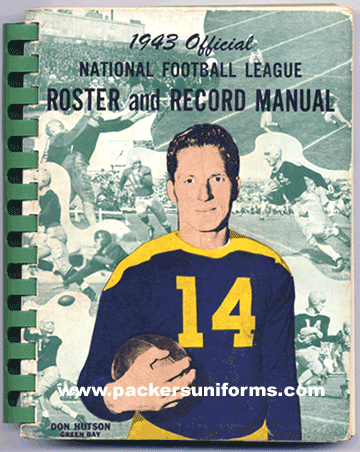
The numbers are what I like to call "Square Block" (anyone out there who knows a more accurate name, a manufacturer's designation, please shout). Note that the "1" is comprised solely of right angles, and the left edge of the "4" is completely vertical. That comports with other images from the early 1940s, including this hand-colored photo from the League's 1943 Record Manual:

By 1944, the Square Block numbers had been replaced with a version of Varsity Block, as seen in this wire photo (click for full image):
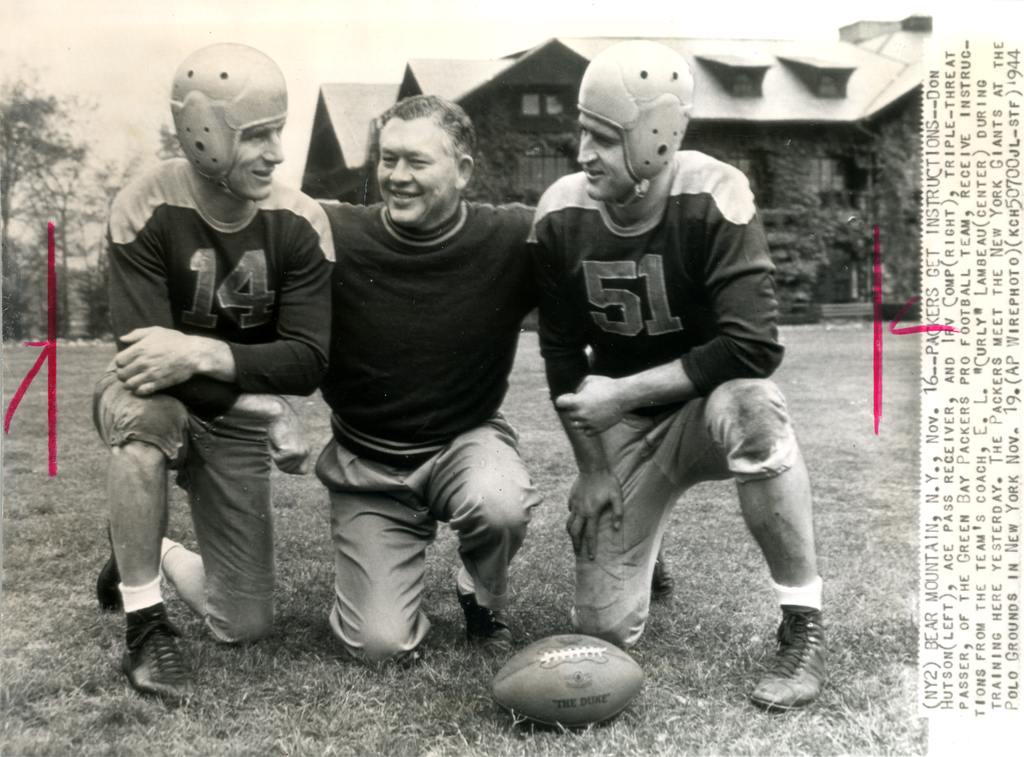
The top serif of the 1 now comes down at an angle and the left edge of the 4 is notched, angling inwards. This is the number style seen on the Hutson jersey on display in the Packers Hall of Fame:

So this Proski jersey would appear to pre-date the one currently on display (which, intriguingly, was also given away to a kid, although not by Hutson himself).

Interestingly, the auction listing offers up yet another style of Packers numbering. Similar to (and predating) the Square Block, this one features an additional flourish on the 4 - a horizontal serif.

You can see a better view of that number 4 here:

I'm researching the various number fonts used by the Packers throughout the team's history (a surprising number), and hopefully will compose a post on the subject soon. It could well be that different players wore different number styles at the same time, especially possible that a long-tenured player such as Hutson might have been holding on to an older jersey. But I don't know. Given the change in styles, I'm not sure that I'd rely upon an admittedly uncertain memory from childhood to conclusively date an item as important as this.

Finally (and curiously), the auction mentions two extant Hutson jerseys. I count three - one in the Packers Hall of Fame, one in the Pro Football Hall of Fame, and this one in private hands. Could this be the one which was hanging in Canton until recently?

It would fit - this jersey belongs in a museum.

UPDATE 02/08/09: I called the Hall of Fame, and they informed me that the Hutson jersey is still in the Hall, just in a new exhibit. Details here.

So that means there are indeed at least three Hutson game jerseys extant - one in each of the Green Bay Packers and Pro Football Halls of Fame, and this one in private hands. Where this one will end up, we may never know.

UPDATE 05/04/09: The auction is over, with a final bid of $60,000. Plus buyer's premium, etc. Not quite the $100,000 that the authenticators speculated, but pretty good in this economy.

Thursday, April 2, 2009

Auction Gold, Part III - You Don't Tug On Superman's Cape

The sideline cape is a uniquely "football" garment. It speaks of cold November games. Players on the sideline, waiting for their turn on the field. Easily cast off onto the ground, as numbers are called and the men rush into the fray.

Because capes weren't worn on the field, they managed to survive for many years. In the case of the Packers, they were still wearing their 1940s/1950s capes well into the Lombardi era, the last vestige of the blue and gold color combination.


Several times in the past several years, these sideline capes have come up for auction. I know of three recent auctions:
  • American Memorabilia, ended 10/18/2007 - sold for $1,902
  • Mastro Auctions, ended 11/24/2008 - sold for $1,400.
  • eBay, ended 01/13/2009 - opening bid $4,500 (unsold)
  • the same item relisted on eBay, ended 02/02/2009 - opening bid $3,999.99 (unsold)

I love those guys at Titletown Nostalgia, but they're aiming way too high with their opening bid. They've had that cape for sale at that price on their website for years with no takers, the market seems pretty clear that the actual value is less than two thousand dollars.

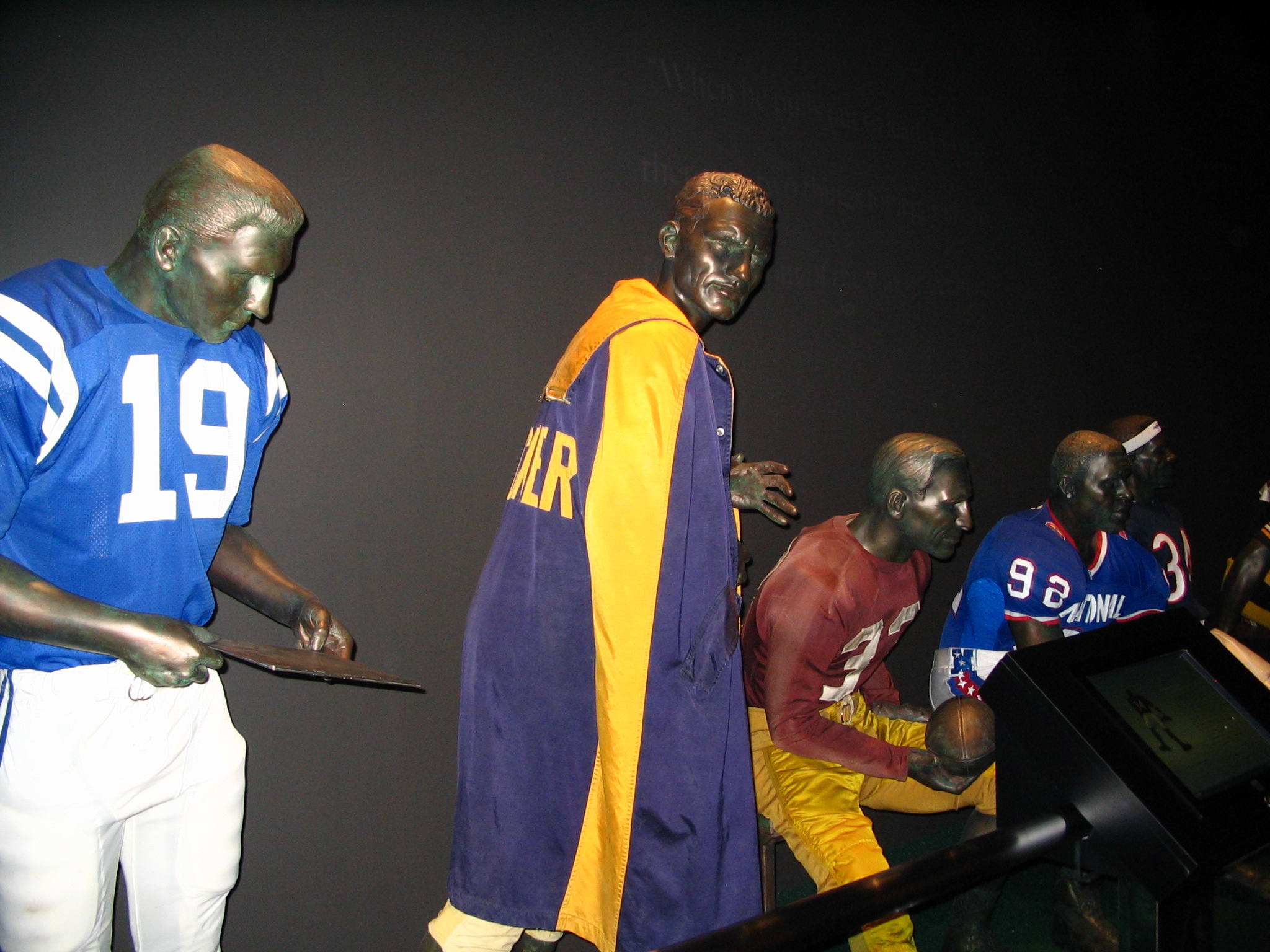
Aside from those auction photos, there's one in the Hall of Fame in Canton:

So much cooler than a sideline jacket.

Tuesday, March 31, 2009

Auction Gold, Part II - Another Hutson Jersey?

Following up on my previous post concerning extant Packers jerseys from the 1940s, I heard a rumor yesterday that another is about to surface.

The word is that Robert Edward Auctions' Spring 2009 auction will include... a Don Hutson jersey.

Robert Edward Auctions is the same outfit which auctioned off the Ken Keuper jersey last year - they only do one auction a year, but sure seem to make them count. And if true, this would make three known Hutson jerseys: one in Canton, one in the Packers Hall of Fame in Green Bay, and one in private hands.

More details as they become available - bidding begins approximately April 10, and the auction ends May 2, 2009.

Man, I'd love to own this. An authentic gamer from the greatest Packer of them all? But something tells me that it'll be just a little out of my price range. Estimates put it perhaps upwards of $100K. Ten times what the Ken Keuper jersey brought at auction last year.

Heck, if nothing else - we should get some great photos out of it. Exemplars from this period are awfully hard to come by.

Monday, March 23, 2009

A Grand Opportunity

The NFL gave us a peek at the upcoming 2009 schedule today, revealing that the Packers will open the season at Lambeau Field against the Chicago Bears in a Sunday Night Football game on Sept. 13, and will visit the Detroit Lions on Thanksgiving Day.

Thanksgiving used to have a special place in the Packers/Lions rivalry - the boys from Green Bay used to visit Detroit every Thanksgiving from 1951 through 1963, when Lombardi pulled out of the traditional matchup. His 1962 Packers, one of the greatest teams of all time, went into Detroit in Week 11 undefeated. There was little for Vince to be thankful for that day, as the Lions handed the Packers their first (and only) loss of the season, 26-14. They would play one more Thanksgiving game against the Lions before the NFL started rotating Detroit's opponents.

It's a real shame that the NFL doesn't do Thanksgiving throwbacks anymore - I'd love to see the Pack adopt one of their classic looks for that game, as they did in 2001 and 2003.

And FWIW, the Lions will be sporting new duds (in an attempt to cleanse themselves of the Millen stink) - the new logo, a 25% fiercer rendering of "Bubbles", has already been leaked by the NFL online shop.

Thursday, February 12, 2009

The Uniform Change That Wasn't

Today, the talk on Paul Lukas' indispensable Uni Watch blog turned to mention of Ron Wolf's proposed 1994 uniform change, thanks to his ESPN.com Page 2 column.

I'll let Paul talk about it in his own words:
"(I) once sent a letter to the Green Bay Packers, urging them to reconsider their plans to change their uniforms and color scheme (this was in 1993, six years before the advent of Uni Watch), and was surprised to get a phone call and a note from Packers CEO Bob Harlan (who, fortunately, later changed his mind about all the uniform changes described in that letter)."
He included a scan of the letter (click to enlarge):

The uniform Harlan describes jives with a contemporaneous account published in the Packer Report, September 18, 1993:

Possible Color Change Outlined

There was a rumor Sunday the Packers would have a press conference concerning their uniforms colors during the week following the Eagle game. This, however, seemed certain: The Packers plan to change their uniforms next season, retaining the current dark green, but switching pants and helmets from the present yellow to metallic gold.

The Packers hope the changes will be approved by the NFL Properties by the beginning of next month so they can wear the new uniforms next season. Among other changes are the removal of stripes now on the helmet, jersey, and pants.

Packer President Bob Harlan told the Milwaukee Journal the gold was not the same as that worn by any other team and that it was selected by General Manager Ron Wolf and Coach Mike Holmgren. Harlan said the helmet would be switched from yellow to gold and have a large green "G" on each side and the jersey would have a smaller green "G" on each sleeve. The white numbers on the green home jerseys and the green numbers on the white road jerseys will also have a gold outline. The pants will be plain gold.

"Years and years ago, we wore a gold helmet and gold pants," Harlan said. "And I think that's what Ron wanted, a simpler uniform. They didn't want to look like New Orleans or the 49ers. They looked at different golds and picked out what they liked."

Of course, the 49ers have since changed their gold, and New Orleans wears about a dozen different shades of gold, so it's not a huge help in determining the shade Wolf and Holmgren picked out.

Here's my interpretation of what this might have looked like, based on those descriptions:

Personally, as a longtime Packer fan... I'd have been okay with this. Heck, I'd be okay with this today. Don't like the plain shell, but add a single gold stripe down the side of the pants and across the seam of the helmet, and it's beautiful. Honors Lombardi's legacy with echoes of Lambeau's. I know, I'm probably the only Packer fan who thinks so, but there you have it.

I also have a recollection of them publicly considering a switch back to Curly Lambeau's navy and gold, but that's probably my faulty memory conflating the 1994 uniform change, announced in late 1993, with the 1994 NFL 75th Anniversary throwbacks.

Again, I'd still have been okay with that. I love the gold yoke, and it would help focus attention on the Packers' glorious pre-Lombardi history, which tends to get ignored in the NFL's general amnesia surrounding the pre-Super Bowl era.

But Wolf eventually decided that he couldn't go through with it. According to an interview he gave the St Petersburg Times:
"I never liked the yellow color in the Packers scheme," Wolf said. "NFL books say it's 'green and gold' but anybody can see it's a Michigan kind of yellow, of maize, which didn't sit well with me.

"I put together a proposal to change Green Bay uniforms, replacing the yellow with a gold much like we see on Rams uniforms and helmets. There were some other changes but I wasn't messing with the "G' on Packers helmets."

Everything was approved by the seven-member executive committee that operates the Packers. All I had to do was give the go-ahead."

I repeatedly looked over drawings of the new Packers uniform, thinking I would soon be pulling the trigger on changes. But, after a little more thought, decided it just didn't fly. We needed to fix what was truly broken. What we really had to have was better people on the field."

If the Packers were ever to move away from Lombardi's uniform, this would have been the time. The Favre era was right around the corner, and Wolf's uniform would be viewed now as the one in which they won a Super Bowl, the one in which they brought glory back to Green Bay.

I'd love to see those drawings Wolf mentioned.
UPDATE: Jeff Ash, assistant online editor of the Green Bay Press-Gazette, mentioned this story on his excellent blog "Out of Bounds" (and was kind enough to give a hat tip). He had something new to add:

"Here's one more little detail I remember from that time:

Wolf wanted to see what the new uniform looked like on the players, but he wanted to keep it quiet. So he enlisted one of his assistants to put on the gear. You might know the guy. He used to be an NFL player. At the time, he was the Packers' director of pro personnel. It was Ted Thompson."

Outstanding. Wonder what Ted remembers of that fashion show?

Wednesday, February 11, 2009

Goodbye, Gridiron Man

Well, it looks like this time he's really done it.

Sure, we've heard it before. But if Favre really has declined to have the surgery on his arm, that indicates he's not intending to throw a football with it anytime soon.

So he retires with 3 consecutive MVPs, not to mention 65,127 passing yards, 464 passing touchdowns, 9,280 attempts, 5,720 completions, and 291 consecutive starts (including playoffs), all of which are the most by any player in NFL history. But let's get to the really important number in Brett Favre's pro career - 15.

Not counting individual game or partial-season patches and tributes, or changes in manufacturer's marks, these are the uniforms Brett has worn in the pros:
  1. 1991 Atlanta Falcons home
  2. 1991 Atlanta Falcons away
  3. 1992-1996 Green Bay Packers home
  4. 1992-1996 Green Bay Packers away
  5. 1994 Green Bay Packers home throwback (09/18/1994 v. Philadelphia, 10/02/1994 v. New England and 09/25/1994 v. Tampa Bay)
  6. 1994 Green Bay Packers road throwback (10/31/1994 at Chicago)
  7. 1997-2007 Green Bay Packers home (eliminating the sleeve stripes pushes this into a new uniform in my universe, and therefore in this blog)
  8. 1997-2007 Green Bay Packers road
  9. 2001 Green Bay Packers road throwback (11/22/2001 at Detroit)
  10. 2003 Green Bay Packers road throwback (09/27/2003 at Detroit)
  11. 2008 New York Jets home (green jerseys/white pants)
  12. 2008 New York Jets away (white jerseys/green pants)
  13. 2008 New York Jets away alternate (white jerseys/white pants, 09/22/2008 at San Diego)
  14. 2008 New York Jets home alternate (green jerseys/green pants, 12/14/2008 v. Buffalo)
  15. 2008 New York Jets/Titans home throwback (09/28/2008 v. Arizona and 10/12/2008 v. Cincinnati)
That's a pretty decent list (and for what it's worth, the Packers and Jets use the exact same shade of Pantone green). What's surprising to me is that one-third of his uniforms were worn in the final year of his career.

Had Favre stuck around for one more season, he would have worn the New York Titans road throwback the Jets are about to unveil. And yet, when I think of his career, I'll always see him wearing the green and gold at Lambeau. I suspect that in a couple years, the image of him as a Jet will seem as strange to our eyes as a picture of him in Atlanta black does now.

Goodbye, Gridiron Man. Looking forward to the inevitable ceremony taking #4 out of circulation, and a trip to Canton in 2014.

Tuesday, February 10, 2009

Getting Ugly, Chapter 2: Getting Uglier

Following up on the new prototype jerseys that the Packers have been testing in practice comes this article about the Pro Bowl jerseys:

Reebok tests "stretch mesh" jersey at NFL Pro Bowl
By JAYMES SONG

HONOLULU - National Football League players were outfitted on Sunday with Pro Bowl jerseys made from a new material Reebok is testing and believes can improve athletic performance.

The "stretch mesh" jerseys are nearly 20 percent lighter than the standard NFL jersey and aim to allow for more range of motion, better ventilation and temperature control.

If all goes well, a number of teams will use the material next season.

The jerseys are also supposed to provide better fit and comfort, but don't tell that to New York Jets defensive tackle Kris Jenkins.

The 6-foot-4, 349-pound Jenkins first put on his AFC jersey for photo day and practice Friday, and it appeared two XL sizes too small, looking more like a crop top.

"I've been holding my breath since the pictures," Jenkins said.
And this great video from NBC's coverage of the game:


Don't mince words, Kris. How do you really feel? This highlights one of the concerns I've had about the move to spandex unitards: for every cut wide receiver on the field for any given play, there are several linemen who won't be exactly flattered by the body-paint look.

I'm very wary about the new jerseys. Design-wise, I'm wary about everything that has anything to do with the Pro Bowl:

The worst thing about moving the Pro Bowl to the week before Super Bowl is that the game, and its uniforms, will be much harder to ignore. Which I guess is the point from the NFL's perspective but sure seems like a lose-lose to me.

Sunday, January 11, 2009

Where did Don's jersey go?

In an earlier post, I wrote about the known Lambeau-era Packers jerseys still in existence. There are two Hutson jerseys of which I am aware - one in the Green Bay Packers Hall of Fame, and one in the Pro Football Hall of Fame in Canton.

Well, it looks like something has happened in Canton. Here's how I remember it from my last visit (which was admittedly several years ago):

Look at the three jerseys in the middle: from left, there's Don Hutson's #14, Sid Luckman's #42, and Bob Waterfield's #7.
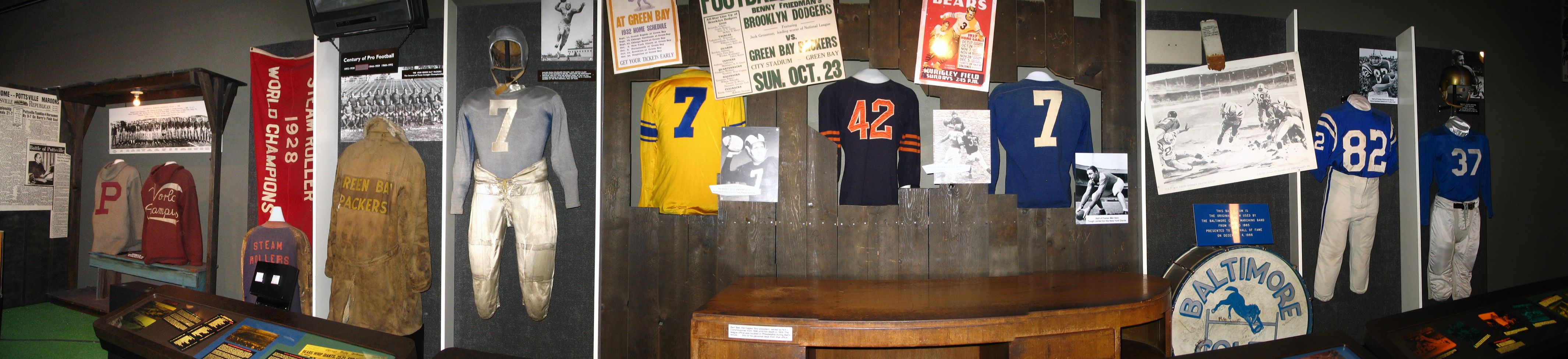
But that was then, this is now. The photo below was taken just over a month ago, on December 8, 2008, by Flickr user KaylynStar:

(click to super-enlarge)

The Hutson jersey is gone, with Waterfield's LA Rams jersey moved over to take its place and a Mel Hein Giants jersey now on the right. Waterfield's still has the Packers posters surrounding and overlapping it, making for a slightly incongruous display.

So what happened to take Hutson's jersey off display? Any other Canton visitors able to tell me when it was removed?


UPDATE 02/08/09: I called the Hall of Fame, and they informed me that the Hutson jersey is still in the Hall, just in a new exhibit. It was moved last May to the new "Moments, Memories & Mementos Gallery".

The Moments, Memories & Mementos Gallery climaxes with a dramatic bench scene featuring nine iconic members of the Pro Football Hall of Fame. The stories of Johnny Unitas, Don Hutson, Sammy Baugh, Reggie White, Walter Payton, Joe Greene, Jim Brown, Anthony Muñoz and George Halas are displayed through life-sized figures clad with authentic mementos from the Hall’s collection. The careers of these Hall of Famers are summarized through touch-screen video presentations.
The jersey's partially obscured by the sideline cape, but there it is:

And here's a reverse of the bench (although you can't see the jersey):

There's a (very tiny) picture of the complete bench display on the HoF's site. You can just make out the jersey, second from left.


Mystery solved.

Monday, December 22, 2008

Auction Gold

Cruising around past auction archives can net some real treasures. From Robert Edward Auctions' 2008 auction comes this beauty.

The auction description:
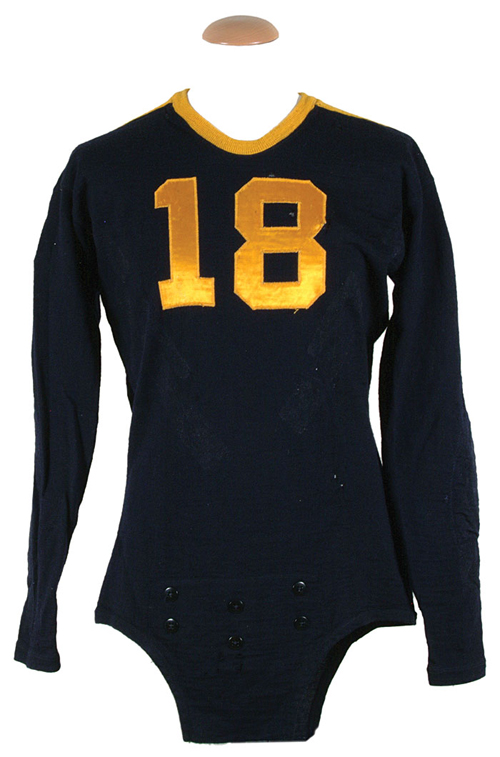
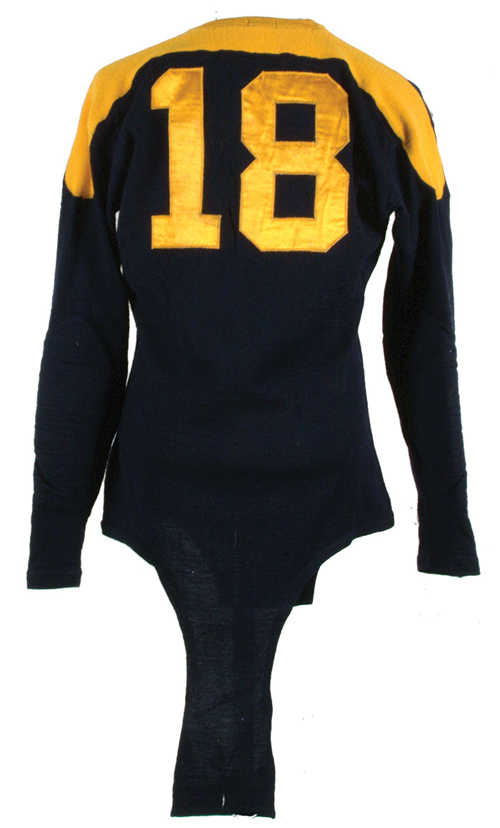
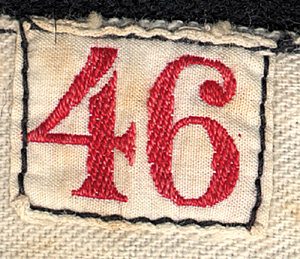
This museum-quality NFL jersey holds the significant distinction of being, to the best of our knowledge, the earliest known Green Bay Packers jersey in existence and can be narrowly dated to the three-year period 1945-1947, when it was worn by defensive back Ken Keuper. Graded A9.5 by MEARS. The black knit jersey is trimmed in gold along the collar and sleeves, and features full-length sleeves (with padded elbows). The number "18" is appliquéd in gold tackle twill on the front and reverse. An "O'Shea" manufacturer's label appears in the collar, and a "46" size tag is located on the crotch piece. Original and unaltered, the jersey displays moderate -to-heavy wear including a number of small holes on the front, and a vintage team repair on the reverse. The dating of this jersey, as well as its attribution to a specific player, was determined by a combined analysis of the manufacturer's tag, jersey style, and size/number (a comparison was made between the size of this jersey to the height and weight of the only two players who wore this number during its years of possible use). Based upon all three criteria, the jersey could only have been worn by defensive back Ken Keuper between the years 1945 and 1947, his only three seasons with the club. During Keuper's three years with the club he appeared in a total of thirty-eight games and recorded six interceptions. The Packers finished in third place in the Western Division each season between the years 1945 and 1947. The Green Bay Packers are the third-oldest team in the NFL and also the most successful. The Packers won a record eleven NFL Championships between the years 1922 and 1965, as well as three Super Bowls. Despite their storied history, pre-1960 Green Bay Packers jerseys are exceedingly rare and this is what we believe to be the earliest example known. It is also the fourth-oldest NFL jersey for any team listed in the MEARS census (the earliest is a circa 1933-1934 Bears jersey). This is a remarkable jersey in all respects and, given the legendary status of the franchise, one of the most significant surviving relics in NFL history. Graded A9.5 by MEARS (10 point base grade, but minus a half point for the small holes on the front). This jersey has been consigned to this auction directly from the personal collection/inventory of world-renowned bat and jersey authenticators David Bushing and/or Troy Kinunen. LOAs from Dave Bushing & Troy Kinunen/MEARS. Reserve $2,500. Estimate $5,000+. SOLD FOR $9,987.50
Wow. $10K. A little out of my price range, but I love the photos.

Outstanding in all its details:

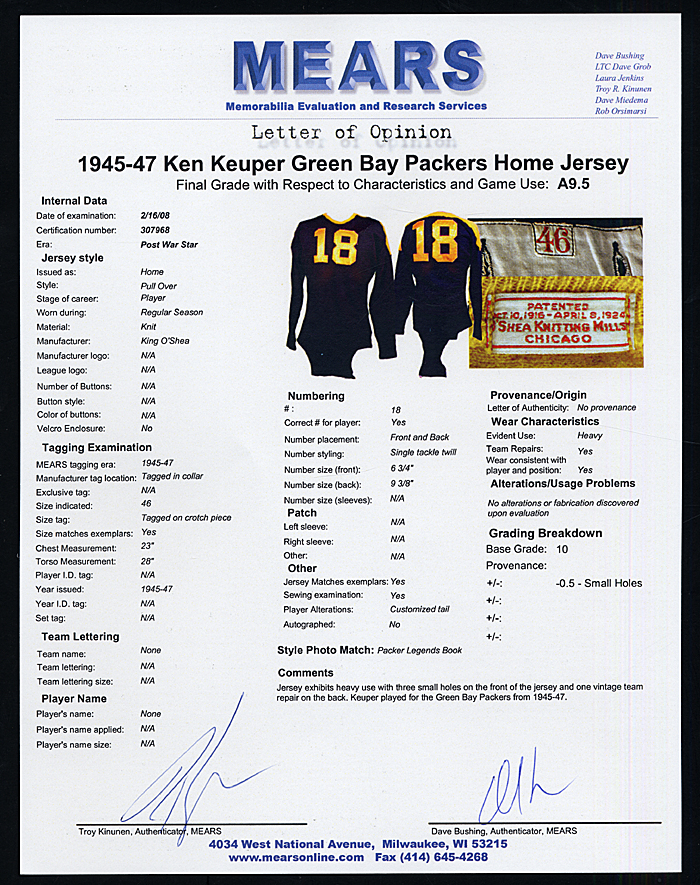
But the real gem is the authentication paper:

An amazing opportunity to get actual data on the classic jerseys, especially the numeral measurements. Helpful for making those replicas.

So few of these old jerseys still exist, although MEARS is wrong on one point - if their attribution is correct, this is not the oldest known Packers jersey in existence.

I don't know which one is the extant packers jerseys is the oldest, but I do know of at least two Don Hutson jerseys in museums. Hutson played until 1945, which would make them at the very least as old as the earliest date they've assigned to the Keuper jersey.

The Packers Hall of Fame has one of those Hutson jerseys, donated a couple years ago by the family which used to run the Rockwood Lodge.

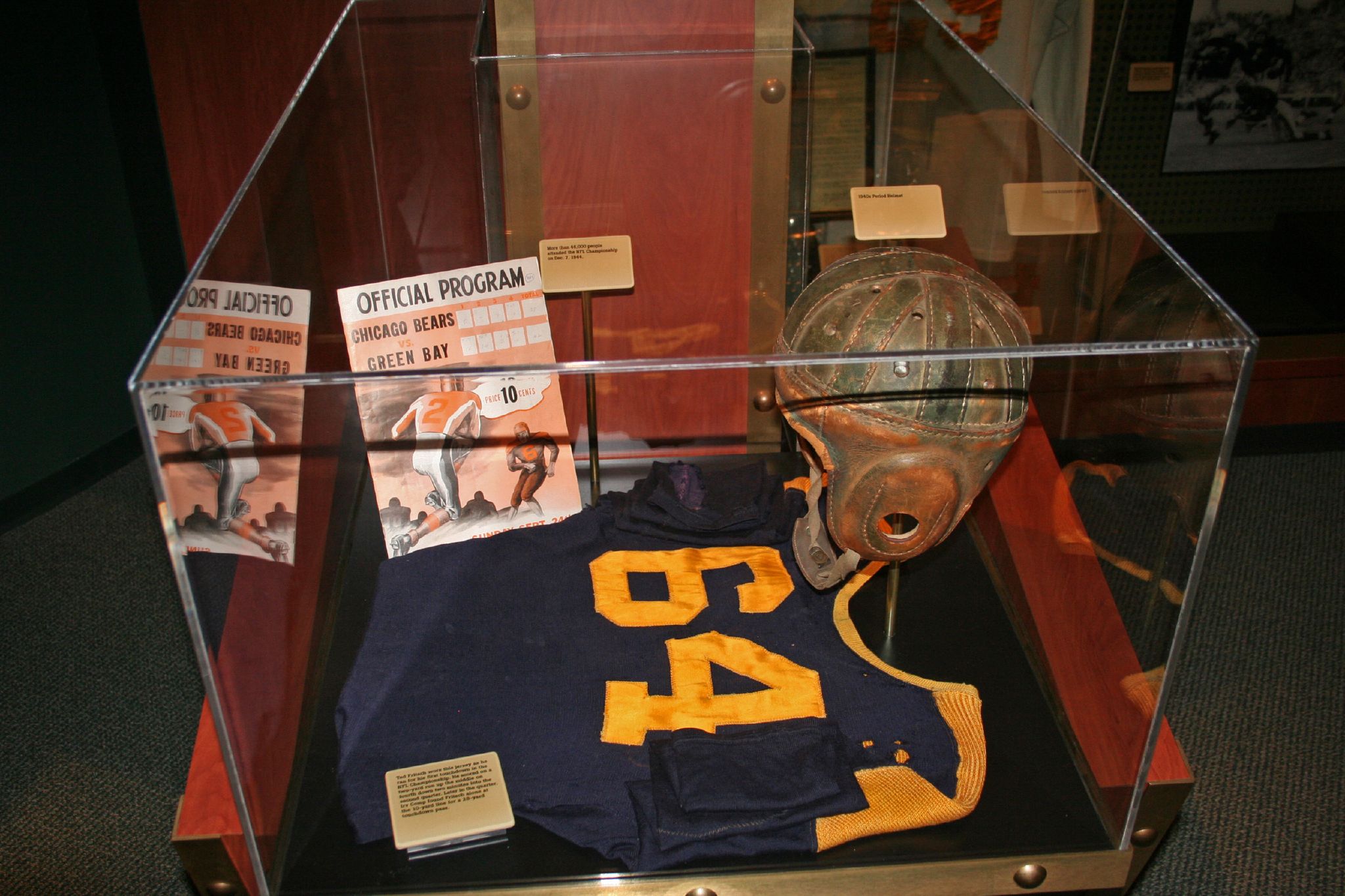
The second one's in Canton (kind of hard to see - it's the jersey on the left, you can make out the "4"):The Green Bay Packers Hall of Fame has other old jerseys, including this beauty worn by Ted Fritsch in the 1944 Championship Game against the Giants (Lambeau's sixth and last World Championship).

The memorabilia store All-American Sports in Milwaukee (on National, right around the corner from Miller Park) has a framed 1940s jersey in its store, or did about five years ago. How many other jerseys are in private hands may never be known, but the number can't be that high.

I don't know which one is oldest, and maybe we never will. They're all gorgeous, though. Such an elegant design. Navy and gold compliment each other, and the gold yoke is pure class. The 1994 throwbacks didn't even come close to capturing its spirit.