Monday, May 18, 2009

More on Forged Favre Gamers - Shades of Gray (Flannel)

Chris Nerat's article on forged Favre gamers brought to mind a story from my own collecting history. In 2004, Vintage Authentics offered up for auction an honest-to-goodness 1994 blue and gold home NFL 75th Anniversary throwback Favre gamer. With my love for the throwbacks, I was very interested in making a run at it.

Here's the photo which accompanied the auction page:


Based on that picture, I had some serious doubts about its authenticity. Even though this was years before Mitchell & Ness started making their version of this beauty (and the glut of counterfeits which emerged as a result), there were three dozen known and extremely authentic-looking forgeries out there in the hobby. Top-notch forgeries which had been introduced to the market by... the Green Bay Packers.

In 1998, Grey Flannel Auctions contracted with the Packers for the club to provide custom jerseys for an auction. The Packers took thirty-six unused jerseys supplied to the team by Ripon Athletic, but not actually issued by the team to any player, and "repurposed" them with Favre numbers and nameplates.


Here's another example (click to enlarge):


Because they started out as unworn gamers, each of the dummy Favre jerseys has the sheen of authenticity. Naturally, they feature authentic team tagging. The name and number font, which so often trips up counterfeiters, are 100% authentic and sewn on by the same people who prepared all the actual game-worn jerseys. Many, if not all, of the usual markers that authenticators look for on a gamer are present on these.

In addition, each of the Grey Flannel jerseys came complete with a letter from Packers equipment manager Red Batty explaining its unusual history.

As Batty mentions in his letter, they also manufactured some copies of the road version (it is unclear how many of the thirty-six produced were home or were roads). This one comes up for sale on eBay from time to time, along with its own copy of the letter:


The easiest way to identify the repurposed jerseys is by the size - Favre customarily wore (or "wears," if he comes out of retirement) a 52. The Grey Flannel jerseys, having been issued to multiple other players, may be found in a whole series of sizes. Both of the home blues pictured here are size 46, while the road is a 48.

Frankly, I'm not sure how good an idea this was on the Packers' part. It's not like there wasn't a market in game-used jerseys ten years ago, that they would be unaware of might happen with some of these jerseys. It seems almost inevitable that somebody would try to sell them as authentic Favre gamers, which is exactly what happened with the Vintage Authentics auction.

Then again, if I ever saw a Favre '94 throwback gamer, I'd automatically presume that it came from the 1998 Grey Flannel auction. The numbers just lean that way - presuming Favre's standard two jerseys per game, times four throwback games (three at Lambeau Field, one in Chicago), plus maybe a couple extras for team-issued backups not worn, still equals less than a dozen. Grey Flannel had the Packers prepare three times that many ersatz jerseys.

In any case, it was that "46" tag that really made me question the jersey in the first place, knowing that Favre's usual size is a 52. I can see occassionally wearing a larger size over layers for cold-weather games. But a smaller size? Seemed unlikely to me. When I saw it, I called American Memorabilia to confirm that it was actually game-used and not one of the 36 dummies. The rep with whom I spoke was unaware of the Grey Flannel jerseys, and said they would investigate.

I called again to inquire, and was told that from Grey Flannel they had learned each of the thirty-six was discretely marked in such a way as to alert an authenticator, hopefully preventing an auction house from making an honest mistake and incorrectly attributing it. The jersey in question was quietly removed from the auction.

A shame, because I was more than happy to buy it as a repurposed jersey. Vintage Authentics, no doubt feeling burned by the attempted fraud, wanted no part of it and the jersey disappeared.

The following year, American Memorabilia also fell victim to a scam, when this jersey was offered in their catalogue:


1994 Brett Favre Game-Worn Packers Throwback Jersey
This 'throwback' jersey, was worn by the league's most prolific 'throwback,' Brett Favre. There is not a man who's tougher or more determined to win than the league's only three-time Most Valuable Player. In 1994, the NFL's 75th Anniversary, all teams wore the same style uniforms that were worn in the days when facemasks were faces. This Packers white road 'throwback' jersey was one of the few ever put to use by Favre. Light wear, with underarm pilling, is exhibited on this shirt, with a "75th Anniversary" patch affixed at the left breast and a "Starter" tag in the tail. A unique "44" swatch tag is also showcased on this brilliant shirt, with customized, ribbed sleeves and all sewn-on identifiers.
No mention of Grey Flannel, no accompanying letter, but take a look at the size - 44. The first big clue that Favre never actually "put it to use," light wear and underarm pilling notwithstanding. By this time, however, collectors were getting wise - the jersey opened at $900 but failed to draw even a single bid.


I'd still like to have one in my collection someday. The blue and gold throwbacks are perhaps my favorite Packers uniform to date, and given their relative scarcity I'd settle for one of the repurposed 36 until a real gamer came along. I think there's value in these jerseys based on their lineage, even if they aren't true gamers. But you have to know what you're buying.

Sunday, May 17, 2009

The Complete Packers Helmet History. More or Less.

The NFL shop is currently selling this long-sleeved tee, which they're styling as the "Reebok Green Bay Packers Helmet History T-Shirt":

The complete Packers helmet history, right there on your chest. Kinda. Well, if you don't count the first four decades.  Or the 1950s white helmets.  But hey, at least they managed to acknowledge something from before the Ice Bowl.

I really hope that's an old product - "87 years of Packers football" and all that. Because if that shirt isn't from 2006, then they're counting from 1921, and we're back to ignoring the pre-NFL days. I thought we had gotten beyond that.

There's an interesting debate brewing on Uni Watch right now over the Detroit Lions version of the shirt, which seems to have some historical inaccuracies (it's not clear if the Lions ever painted their helmets gold, and even if they did that wasn't the year listed).

The Packers version does seem a pretty good review of everything from the post-leather days, but I can't quite make out some of the helmets from this promotional picture, and curiously enough they've included the 1994 throwback helmet but not the 2001 throwback. Guess one-offs don't make the cut.

In any case, I'm pretty sure that satisfying my curiosity isn't worth $21.99. Even if it is "$4.99 Standard Ground Shipping Eligible!" And especially since I'd never actually wear the thing.

Friday, May 15, 2009

ALERT - Forged Brett Favre Gamers

Chris Nerat, of Titletown Nostalgia and the related Collect Green Bay blog, recently posted an article he wrote last year for Sports Collectors Digest. It should be mandatory reading for anyone interested in game-worn Packers jerseys, let alone anybody even thinking about purchasing one.

In short, Chris details the story of Steve Towes, a collector who learned that two of the Brett Favre gamers he owned were forgeries. And not even very good ones. He didn't vet the jerseys very thoroughly, because they came from what he considered an impeccable source - Rick Radke, owner of Radke Sports and BrettFavreAutographs.com, the official supplier of Favre-signed memorabilia.

Not only was the source itself seemingly beyond question, but the jerseys he bought came with plenty of documentation proudly proclaiming their authenticity:

Towes assumed the authenticity of the jerseys was as solid as possible. Both pieces had Favre’s personal authenticity holograms affixed to the tackle twill numerals, Favre’s signature neatly scribed on each jersey’s back No. 4, and inscriptions written in black felt-tip marker assuring the potential buyer that they were “Game Used” — a hobby term that is music to serious collectors’ ears.

In addition, each jersey was accompanied by a “Letter from the Desk of Brett Favre,” which was also signed by the three-time NFL Most Valuable Player, stating that both were used during game play by the Green Bay quarterback. And, each came with a picture of Favre with the jersey.

After payments to Radtke that totalled $13,000, Towes became the owner of both showpieces, which he displayed in his Wausau, Wis., home.

Towes eventually became suspicious, had his jerseys looked at by an authority, who declared them forgeries, intended to deceive.

To his credit, when alerted Radke took back the fakes and refunded Towes' money. Perhaps Radke was himself another victim of the scam.

Now, I'm usually pretty wary about Certificates of Authenticity and all that, given that they rest solely on the credibility of whoever signed them. And most auction houses appear to be more interested in collecting the Buyer's Premium than protecting their reputations. But if I bought from Favre's official supplier directly, I suspect that I'd be comfortable enough to let my guard down.

You have to read this story for yourself.

Click here to read the article (PDF)

It's actually a follow-up to an earlier article Nerat wrote for SCD, which is available on their website.

This is really scary stuff - if I ever did have the money to buy a Favre gamer, I would have bought it through BrettFavreAutographs.com without question.

Along a similar line, I once had a brush with forged Favre jerseys myself.

Remember - Caveat emptor, now and forever. Trust, but Verify. Whatever cliché you want to use, it's good advice.

I hope Nerat, who no longer writes for SCD, is able to do another follow-up. I'd love to learn more about who was behind the scam.

Tuesday, May 12, 2009

A New Mystery - "Lombardi on the rocks"?

While doing some research on the New York Times website for an upcoming post, I came across this February 4, 1969 article about Vince Lombardi's defection to Washington.

Something in the first sentence struck me:

Not the per capita number of bars in Green Bay; that shouldn't come as a surprise to anybody (especially since Curly Lambeau used the area's lax enforcement of Prohibition as a recruiting tool in the early days), but by the mention of a drink named after Vince Lombardi.

What the heck is a "Lombardi on the rocks"? Anybody come across this one before? Is that anything like a "Milwaukee martini," slang for beer with a Spanish olive? Perhaps a little creative license on Eskenazi's part? Or was there a real local cocktail named in Lombardi's honor?

I really hope it's the latter. If anybody can shed some light (or even better, can supply a recipe), please drop me a line.

Thursday, May 7, 2009

You Don't Look a Day Over Eighty-Nine

Today, the Packers released a logo to commemorate the team's "90th Birthday" (hat tip: Ryan):

From the press release:

Team Turns 90 Aug. 11; Logo, Contests To Mark Occasion

As the story goes, George Calhoun had a chance meeting with Earl 'Curly' Lambeau on a Green Bay street corner in the summer of 1919 and the two discussed starting a football team. A few weeks later, on Aug. 11, the two called a group of young athletes together to organize a team...the gathering marked the beginning of the Green Bay Packers.

This summer will mark the 90th birthday of the Packers, and the organization will celebrate the occasion with a "90 Years" logo, an online trivia contest and other fan activities.

"As the team marks its 90th birthday on Aug. 11, we look forward to celebrating nine decades, 12 world championships and several generations of Packers fans," said Craig Benzel, Packers director of marketing and sales. "We have a number of ways for fans to participate throughout the season."

The online aspect of the birthday celebration will feature a special page on Packers.com that will greet fans and invite them to participate in a trivia contest with questions that will span the 90 years of the team's history.

This summer's Packers Family Night will help celebrate the occasion with a 90th birthday party theme. The night will feature a special fan giveaway item, birthday-related activities and on-field promotions that incorporate the birthday party theme. More details about Family Night, including the date of the event and ticket sales information, will be announced this month.

Among the other team areas that will feature the logo include game tickets, Curly's Pub and the Packers Hall of Fame. The Packers Pro Shop also will offer a number of items that feature the logo.

More highlights of the team's birthday celebration will be detailed in the coming months.

The article doesn't say, but if they're going to market merchandise with this logo I'm presuming that it will also see service as a jersey patch. We'll see.

There's some real good in this logo. I've long been an advocate of the Packers promoting (heck, acknowledging) 1919 as the date of founding. Few things bother me more than the stupid "Est. 1921" that they put on merchandise. The Packers have a long tradition that pre-dates the NFL; why pretend otherwise? So that does my heart good to see.

On the whole, the design is pretty good. Clean and easy to read, team logo prominent, no superfluous elements. It's not perfect - I'm not a fan of multiple outlines around anything, and three outlines around the numbers is way too much - but it's not bad at all.

Presuming that this will become a patch, it provides us with an excellent excuse to look at the way the Packers have honored other milestones on their uniforms.

The first milestone to make the uniform was the NFL's 50th Anniversary. For the 1969 season, all players wore a commemorative patch on their left shoulders:

A long uniform-patch drought would follow: the next anniversary to be so noted was the Packers' 75th Season, which was celebrated in 1993.

The 75th Anniversary logo was too complicated to embroider, so the jersey patch was a simplified version of the logo, minus the banner:

For the first time, the patch was worn on the left breast (television numbers had moved to the shoulders in the years since 1969, fleeing from the players' arms in advance of the retreating sleeves).

I really like this one. It's simple and elegant (although the Starter-jacket-ish speed lines above the diamond do speak to the era in which it was designed). Again, we wait for details on the 90th Birthday patch. But I'm guessing that the logo was designed to be simple enough to translate on a jersey and won't need another version.

The following season, in 1994, the entire league celebrated its 75th Anniversary. It was commemorated with a patch just slightly less elegant than that of the Packers' diamond anniversary:

This one was also placed on the left chest (click for larger):

I suppose it could have been an attempt to put them over a player's heart, like a soccer team's crest or police officer's badge. Or maybe it could just be the only couple square inches of real estate left on the uniforms.

The NFL 75 patch was also featured during the special League-wide throwback uniform promotion, on my own personal favorite Packer uniform:

Which means, of course, that the patch lives on with throwback jerseys you can buy today:

And after tribute patches in consecutive seasons, that would be it until the NFL added Super Bowl logo patches, beginning with Super Bowl XXXII in San Diego:

About which game I have nothing more to say.

The next commemorative patch would worn for the first two home games of 2003, marking the rededication of Lambeau Field following a three-year, $295-million renovation.

Four years later, in 2007, Lambeau Field celebrated another milestone: its 50th birthday. That inspired another logo:

and another jersey patch:

This time, the patch was only worn on the green home jerseys, not the road whites. When the Packers travelled to Dallas for their Week 13 matchup, the Cowboys elected to wear their own navy throwbacks, meaning the Packers would dress in their road whites (unlike most games in Texas Stadium, when the Cowboys' white home jerseys force visitors to wear their colored jerseys). Had the Packers worn green in that game, the Lambeau Field patches would have been removed and sewn back on for the next game in Green Bay.

We've already discussed the over-the-top Gene Upshaw memorial patch from last season. And that rounds up the list of commemorative patches on Packers uniforms.

If this "90th Birthday" is any indication, it looks like they're sticking with this new honoring scheme, years instead of seasons, which results in nice round numbers (1957-2007, 1919-2009).

Let's hope the Packers have something special planned for 2019.

Wednesday, April 29, 2009

Off the Cuff

A good uniform blends design and construction together in a seamless unity. For a team as traditionally-minded as the Packers, the two sometimes come into conflict, and nowhere is this more evident than in the sleeve striping.

I've complained before about the problem of using sleeve stripes on jerseys which no longer have sleeves.

So how did we get here?

The Packers first used sleeve stripes in 1923, sporting gold jerseys with a series of thin navy stripes:

This experiment proved short-lived, however, and for most of Lambeau's time as coach the Packers would shun sleeve stripes for other distinctive design elements such as the gold shoulder yoke.

Stripes would next be seen on Packer sleeves after Lambeau's departure, as new head coach Gene Ronzani tried to put his stamp on the franchise. In 1950, the Packers alternated between kelly green jerseys and gold jerseys, both with two thin stripes on each sleeve:

When Lisle Blackbourn took over the reins in 1954, he brought his own uniform designs, this time incorporating Northwestern stripes.

And, of course, when Vince Lombardi took over the club in 1959, he created his own uniform set. Lombardi's sleeves were similar to the basic Northwestern striping pattern, but with two sets of Packer helmet-style stripes against a gold stripe.

The "TV numbers" were bumped from the sleeves to the shoulders in 1984, but other than that Lombardi's stripe pattern lasted for decades, even as the sleeves themselves were cut shorter and shorter.

In some cases, parts of the sleeve striping were cut off entirely as players cut down their jersey sleeves into cap sleeves, as seen in this photo of Reggie White immediately after the 1996 NFC Championship Game.

Remember, this was taken before the Favre photo above.

The next year, Nike took over the Packers' uniform contract and made the lineman pattern standard for all players:

When Reebok took over the uniform contract in 2001, they kept Nike's pattern, which continues to this day.

Not the best solution, watering down Lombardi's design, but at least it creates some consistency across all players on the field. Note also that, because of the uniform construction, the stripes no longer extend all the way around the sleeve.

Other teams have faced this problem, some ditching sleeve stripes altogether because so few players actually wear sleeves.

The 49ers came up with a pretty creative solution for their new uniform design for 2009, unveiled at their draft party last Saturday: the sleeves are designed at an angle, deliberately running into the sleeve cuff.

Over pads, this creates the illusion of perfectly horizontal stripes and hides the fact that the lower stripes aren't actually complete:

Lest anyone think this is an unintentional side effect of the players chopping down the sleeves, the Niners have the unique sleeve pattern represented in the official style guide:

It also appears on the replica jerseys sold to fans:

We'll see how this actually looks on the field, if it's a viable solution for teams that want to preserve traditional striping patterns. And then we'll see again how they look when the new jersey fabrications start appearing in 2010.

If this solution manages to make the sleeve stripes look good on the new template, the Packers may wish to consider adopting it. Going back to gray facemasks, on the other hand... well, that's a subject for another post.

Friday, April 3, 2009

Auction Gold, Part IV - Yes, Another Hutson Jersey!

Following up on my earlier post, the report of another Hutson jersey going up for auction is true, and man oh man is it gorgeous.

The Robert Edwards Spring 2009 Auction Preview is now up. The photos aren't as great as I'd hoped, but the jersey itself is amazing:

Here's the auction listing:
LOT 1358: 1937-1945 Don Hutson Green Bay Packers Game-Used Home Jersey with Phenomenal Provenance

Robert Edward Auctions has had the privilege of handing a number of historically significant football jerseys over the past few years, including those worn by Jim Brown and Jim Taylor, but this offered garment may be the most important to date: a Green Bay Packers home jersey worn by Hall of Fame wide receiver Don Hutson. To the best of our knowledge, this is one of only two Don Hutson Green Bay Packers game-used jerseys extant and the only example in private hands (the other resides in the Green Bay Packers Hall of Fame). Equal in significance is the jersey's impeccable provenance. Don Hutson personally presented this jersey to our consignor, Joe Proski, in either 1944 or 1945 as a birthday present. Joe "Magic Fingers" Proski is a sports celebrity in his own right, as he was an NBA trainer with the Phoenix Suns for thirty-two years (he was with them at the inception of the franchise in 1968) and is a member of the team's famed "Ring of Honor." Proski was born into a sports family. His father, John Proski, was a longtime employee of the Green Bay Packers, first as an equipment manager/asst. trainer with the club during the 1920s through the 1950s, and then as Lambeau Field stadium director from 1957 until his retirement in 1975. It was through his father's affiliation with the club that he obtained this jersey. As he attests in his accompanying handwritten letter, "The enclosed Don Hutson jersey #14...has been with me and my family since 1944? It was given to me by Don on my 5th or 6th birthday when my dad would invite Packer players over for my birthday party...I wore the jersey all the time when I would play football with my brothers. This jersey has been washed many times." The blue wool jersey, with gold trim along the shoulders, features the number "14" on the front and reverse. All numbers are appliquéd in gold satin. The manufacturer's tag, which was originally located on the the crotch piece, is no longer present (most likely a Shea Knitting Mills label). All six original buttons remain firmly anchored to the crotch piece. As noted in MEARS' accompanying LOA, this jersey style was worn by the Packers from 1937 to 1948, but Hudson's career only spanned the years 1935-1945; therefore the jersey is technically dated 1937-1945. However, Proski recalls that he received this jersey on either his fifth or sixth birthday, which, based upon his age, would more narrowly date the jersey to either 1944 or 1945. The jersey is all original, with no alterations, and displays heavy wear throughout, including a number of small tears/holes and various team repairs on the front and reverse.

Don Hutson was the game's first great wide receiver and one of the most influential players in NFL history. No history of pro football or the Green Bay Packers would be complete without a chapter devoted exclusively to him. Hutson's speed and elusiveness made him virtually impossible to defend and he soon became the focal point of every defense. Prior to Hutson's joining the NFL, double and triple teams were unheard of; Hutson made them necessary. Even then he was a virtual scoring machine. He led or tied for the League lead in touchdowns in eight of his eleven seasons, including a career-high 17 touchdowns in 1942. He also led the League in points scored five of his ten seasons. An innovator on offense, he is credited with inventing modern pass receiving by his use of various moves such as Z-outs, buttonhooks, and hook-and-gos. Like Ruth before him in baseball, Hutson did not just break records, he shattered them. When he retired in 1945, he held eighteen NFL records, including touchdown receptions (99, a mark which stood for four decades) and receptions (488, which was over 200 more than anyone else). He was voted the League MVP in both 1941 and 1942. His accomplishments on offense are even more astounding when one considers that like nearly all players at that time, he also played on the defensive side of the ball. As a safety, he intercepted 23 passes during his career and he was also the Packers' place kicker. Fittingly, Hutson was one of the first seventeen inductees into the Pro Football Hall of Fame in 1963, an inaugural class that included such other legends as Jim Thorpe, Sammy Baugh, Red Grange, and Bronco Nagurski.

NFL game-used jerseys dating from the 1930s and 1940s are virtually nonexistent, especially those worn by players of Hutson's stature. This is one of, if not the most significant football jersey we have ever handled, and one that would be tantamount to a 1927 Babe Ruth or Lou Gehrig Yankees jersey in the baseball marketplace. It is also one of the finest we have ever seen with regard to provenance. Joe Proski's father is well known in Green Bay and was a respected member of the Green Bay Packers family for nearly fifty years. One could not ask for a more reputable source. Graded A7 by MEARS (base grade of 10, with 1 point deducted for the missing manufacturer's tag and another 2 points subtracted for the holes/tears). This is the only Don Hutson jersey in the MEARS census and it also represents the earliest Green Bay Packers jersey ever graded by MEARS. This is a museum-caliber jersey that would be the highlight of even the most advanced football memorabilia collection. LOA from Troy Kinunen/MEARS. Reserve $10,000. Estimate (open).

Let's begin with the good. I can't disagree that this is without question the most significant Packers jersey known to exist. Even with the NFL's peculiar myopia where the pre-Super Bowl era is concerned, the stats in the auction summary speak for themselves. With the whole of Packer history from which to choose, Packers historian Lee Remmel puts Hutson right up as the greatest player to wear the green (or navy) and gold:

When asked to name his favorite player, Remmel paused. "Probably from the standpoint of what he contributed to the team, the incomparable Don Hutson," Remmel said, before adding, "I waver between him and Brett Favre."

Anyone who can stand toe-to-toe with the Gridiron Man is a very special player, indeed.

Now to the bad. I am very uncomfortable disagreeing with Troy Kinunen and MEARS. They're pros, and who am I? That having been said, there are a couple of things in that listing which deserve mention.

First of all, according to David Zimmerman's excellent biography of Tony Canadeo, the Packers wore this uniform style through the 1949 season, not 1948. Introduced by Lambeau in 1937, it was replaced in 1950 by new head coach Gene Ronzani, who wanted to put his own stamp on the team.

Second of all, the number style tells us a lot about the jersey's age. MEARS has narrowed the year to 1944 or 1945 based on the owner's age when he was given it, but based on those particular numbers I don't think either of those dates work.

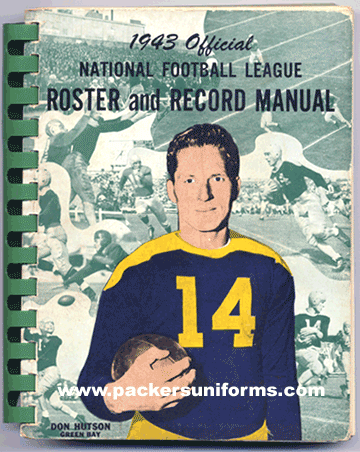
The numbers are what I like to call "Square Block" (anyone out there who knows a more accurate name, a manufacturer's designation, please shout). Note that the "1" is comprised solely of right angles, and the left edge of the "4" is completely vertical. That comports with other images from the early 1940s, including this hand-colored photo from the League's 1943 Record Manual:

By 1944, the Square Block numbers had been replaced with a version of Varsity Block, as seen in this wire photo (click for full image):
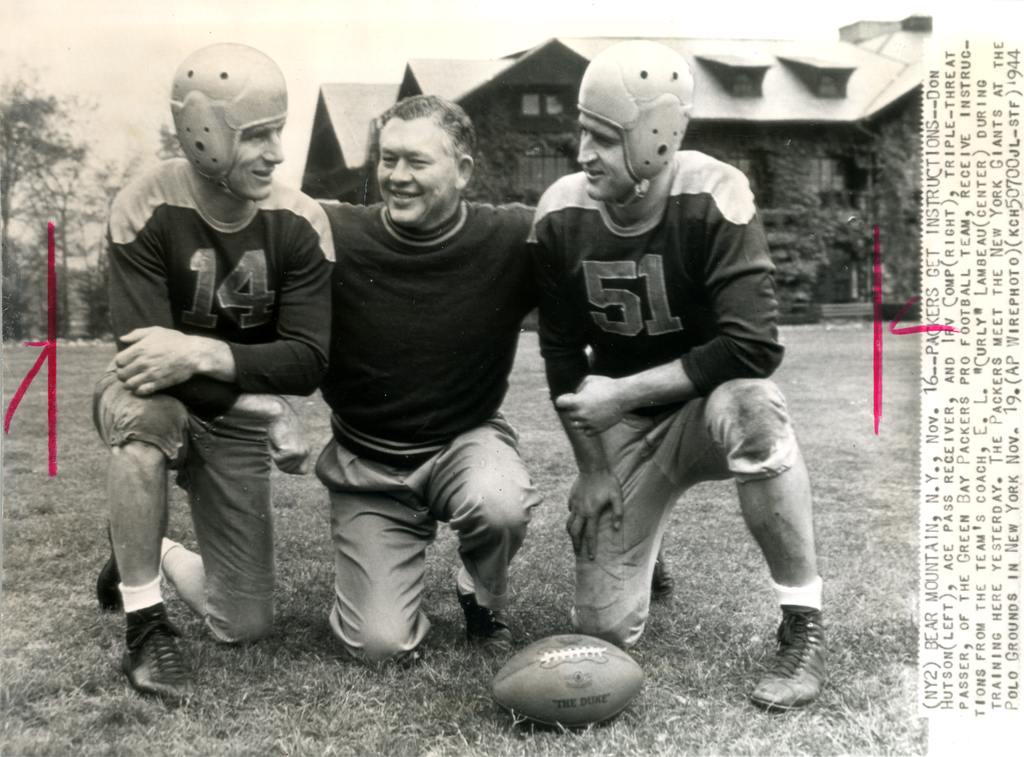
The top serif of the 1 now comes down at an angle and the left edge of the 4 is notched, angling inwards. This is the number style seen on the Hutson jersey on display in the Packers Hall of Fame:

So this Proski jersey would appear to pre-date the one currently on display (which, intriguingly, was also given away to a kid, although not by Hutson himself).

Interestingly, the auction listing offers up yet another style of Packers numbering. Similar to (and predating) the Square Block, this one features an additional flourish on the 4 - a horizontal serif.

You can see a better view of that number 4 here:

I'm researching the various number fonts used by the Packers throughout the team's history (a surprising number), and hopefully will compose a post on the subject soon. It could well be that different players wore different number styles at the same time, especially possible that a long-tenured player such as Hutson might have been holding on to an older jersey. But I don't know. Given the change in styles, I'm not sure that I'd rely upon an admittedly uncertain memory from childhood to conclusively date an item as important as this.

Finally (and curiously), the auction mentions two extant Hutson jerseys. I count three - one in the Packers Hall of Fame, one in the Pro Football Hall of Fame, and this one in private hands. Could this be the one which was hanging in Canton until recently?

It would fit - this jersey belongs in a museum.

UPDATE 02/08/09: I called the Hall of Fame, and they informed me that the Hutson jersey is still in the Hall, just in a new exhibit. Details here.

So that means there are indeed at least three Hutson game jerseys extant - one in each of the Green Bay Packers and Pro Football Halls of Fame, and this one in private hands. Where this one will end up, we may never know.

UPDATE 05/04/09: The auction is over, with a final bid of $60,000. Plus buyer's premium, etc. Not quite the $100,000 that the authenticators speculated, but pretty good in this economy.

Thursday, April 2, 2009

Auction Gold, Part III - You Don't Tug On Superman's Cape

The sideline cape is a uniquely "football" garment. It speaks of cold November games. Players on the sideline, waiting for their turn on the field. Easily cast off onto the ground, as numbers are called and the men rush into the fray.

Because capes weren't worn on the field, they managed to survive for many years. In the case of the Packers, they were still wearing their 1940s/1950s capes well into the Lombardi era, the last vestige of the blue and gold color combination.


Several times in the past several years, these sideline capes have come up for auction. I know of three recent auctions:
  • American Memorabilia, ended 10/18/2007 - sold for $1,902
  • Mastro Auctions, ended 11/24/2008 - sold for $1,400.
  • eBay, ended 01/13/2009 - opening bid $4,500 (unsold)
  • the same item relisted on eBay, ended 02/02/2009 - opening bid $3,999.99 (unsold)

I love those guys at Titletown Nostalgia, but they're aiming way too high with their opening bid. They've had that cape for sale at that price on their website for years with no takers, the market seems pretty clear that the actual value is less than two thousand dollars.

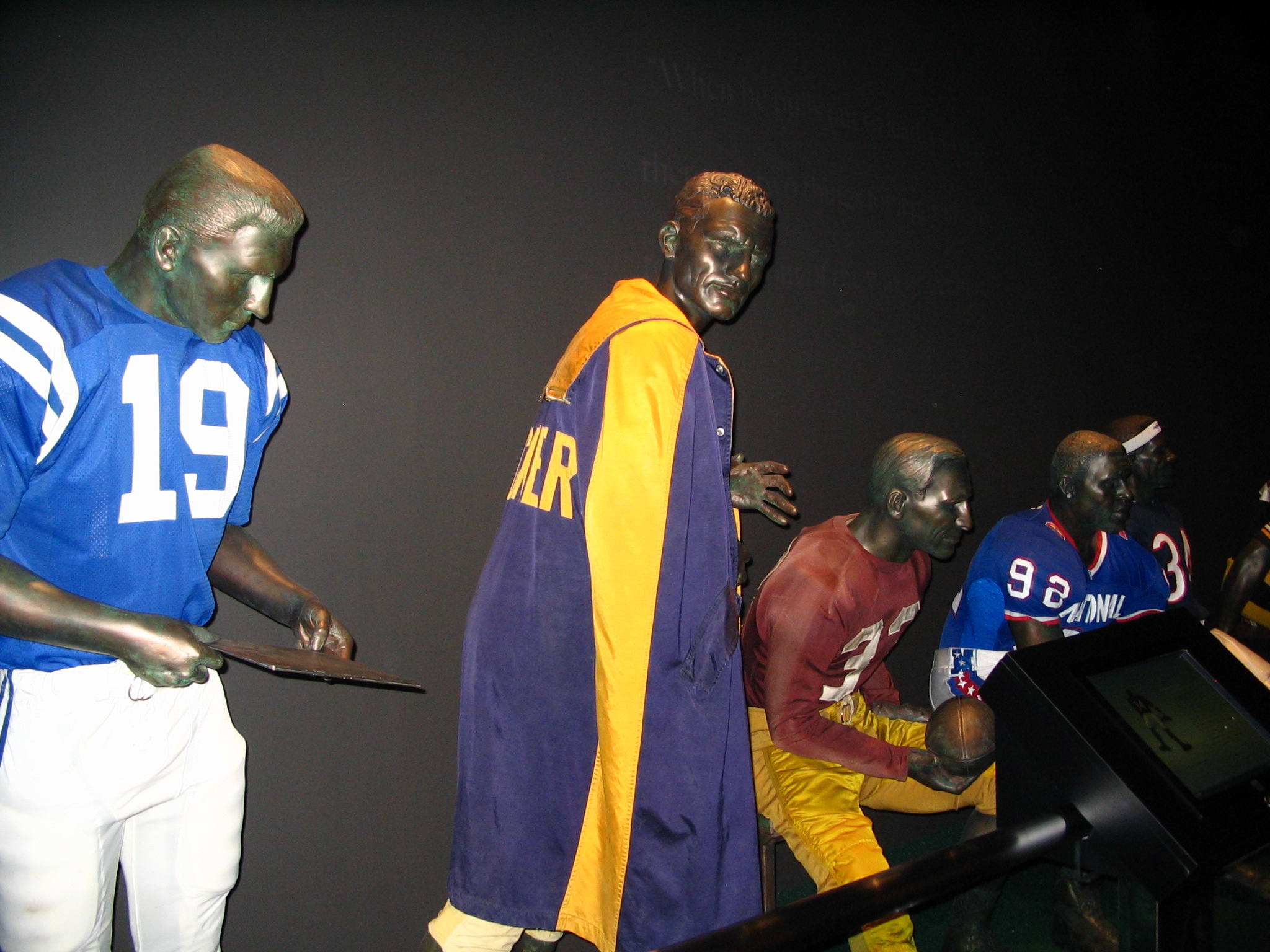
Aside from those auction photos, there's one in the Hall of Fame in Canton:

So much cooler than a sideline jacket.