This signed 1929 panoramic photo, from the estate of a former Packers staff member, is currently up for auction. It shows Curly Lambeau and his men in 1929, the team's first World Championship season.
This uniform, with its blue numbers in gold circles, was worn in 1929 and 1930 and was the inspiration for the Packers' 2010-2014 throwback alternates. In this photo, we also have exemplars of two styles of pullover sideline jackets from the period.
The 1929 squad tore through the National Football League, finishing the season with a 12-1-1 record. The only blemishes in the season were a scoreless tie with the Frankford Yellowjackets and a 16-6 loss to the Memphis Tigers in the final game. Oh, heady days. These men are standing on the cusp of history.
On, you Blue and Gold, to glory, Win this game the same old story, Fight, you Packers, Fight, and bring the bacon home to Old Green Bay.
A nice little tip of the cap from ESPN.com's Paul Lukas, using our 1940 newspaper photos as a springboard to talk about the NFL's color history:
Green Bay Packers to Wear Navy in a 2010 Game by Paul Lukas
ESPN.com March 30, 2010
Courtesy of the Green Bay Packers Can you imagine your Green Bay Packers in an outfit like this?
In case you missed it the other day, the Green Bay Packers recently unveiled a throwback alternate uniform, which they'll wear for one as-yet-unspecified game in 2010. The design is based on what the team wore in 1929.
If the sight of the Pack wearing navy instead of green is a shocker, it shouldn't be. They actually wore a variety of navy-based uniforms for the first several decades of their existence, like this 1940 design. The thing is, color photos from the NFL's early days are rare, so most fans have no idea what their favorite teams used to look like. Neither do many of the game's historians.
That's why a recent discovery by reader Chance Michaels is so amazing. It's a rare newspaper color insert from 1940, providing one of the best views available of the NFL's early color schemes.
Some of the teams are vaguely recognizable — that's an Eagles player at lower right, and a Redskin at lower left (Andy Farkas, incidentally, is generally credited with being the first player to have worn eye-black, even though he's not wearing it in that photo). But it's weird to see Mel Hein of the Giants wearing so much red — and even weirder to see him, as a center, wearing uniform No. 7!
Meanwhile, is that a Cardinals player at upper right? Nope — it's Perry Schwartz of the Brooklyn Dodgers, which was an NFL team for over a decade. And who's that in the center? It's Parker Hall of the Cleveland Rams -- the same franchise that later moved to L.A. and now resides in St. Louis. And they still wear blue and gold, even if the shades have changed.
This rare color photo of Green Bay passer Cecil Isbell was published in the New York Sunday News on September 29, 1940, as part of a photo essay entitled "Pro Grid Aces Who Star Among Stars".
This 23-year-old Houston, Tex., wizard is the football players' football player and rated as one of the most polished performers in the business. He does everything well, but his forward passing is something the fans rave about—and so do his appreciative teammates on the champion Green Bay Packers. In fact this six-foot-one, 190-pound, former Purdue star blazed into fame when he paced an all-star college team and out-passed the famed Slingin' Sammy Baugh of the crack Washington Redskins in 1938. Last year, his second with the Packers, Isbell whipped 73 successful passes—eight for touchdowns—for a gain of 749 yards in 103 tries.
It seems strange to see a quarterback wearing #66, but this picture was obviously taken in the pre-season, when players seemingly wore whatever jersey the equipment manager had handy. Isbell wore #17 throughout his career in blue, as seen in this photo of Isbell and Hutson taken at the All-Star Game on August 29, 1940:
This is Curly Lambeau's classic blue and gold uniform, introduced in 1937. The sock stripes were removed after a few seasons, although it's hard to establish exactly when, as many players of the late 1930s/early 1940s seemed to have eschewed the full socks altogether (at least in the warmer months). In this photo from Wrigley Field, we have one Packer wearing striped socks and Isbell (with the ball) wearing no blue socks at all, only the low whites:
The bare-leg fashion seems to have passed by the mid-1940s, and when socks returned as a permanent part of the uniform they were solid navy, as seen in this 1947 photo:
The stripes would make an appearance on the 1994 throwbacks:
Isbell himself is an underappreciated part of Packers history. Drafted out of Purdue in 1938, he took the league by storm. As the caption notes, he led his team to a surprise win over the Redskins in the 1938 College All-Star Game (which at the time featured the best college athletes against the reigning NFL champions).
Isbell had just as much success in the pros, gradually taking the passer role over from Arnie Herber. He platooned with Herber for the first three years of his career in the "Notre Dame box" formation. This allowed Lambeau to use him as either a passer or a rusher - he led the Packers in rushing in 1938 and 1939, and the entire NFL in rushing average in 1938. As a passer, he led the league in attempts, completions, passing yards and touchdowns in 1941, and completions, yards and touchdowns in 1942.
The 1942 season was to be his last - Isbell only played five years with the Packers before retiring from pro football at 28. He later explained "I saw Lambeau go around the locker room and tell players like Arnie Herber that they were done. I vowed it would never happen to me." Having left on his own terms, Isbell returned to his alma mater as a coach. He has been selected to the NFL's 1930s All-Decade Team despite only playing his rookie and sophomore seasons in the 30s.
Although Isbell was inducted into the Green Bay Packers Hall of Fame in 1972, his short career has led him to be largely, and unjustly, forgotten by football fans. Had Isbell continued to play in blue and gold, he may well have followed Baugh into Canton.
"Hutson and Herber were the absolute perfect combination for a quarterback and a receiver. You had a guy who could throw the ball 65 yards in the air, and you had a reciever who could get downfield and outrun everybody. I mean, the first time Herber completed a pass to Hutson was in a game against the Bears for 83 yards for a touchdown."
- Dan Daly, The Washington Times
That's evident in this set of screencaps showing Herber dropping back and tossing a bomb to Hutson, who separates himself from the defenders and runs it home:
No color this time, unfortunately. But we are treated to a few seconds of the 1937 short film Pigskin Champions, which featured the World Champion Packers in an intrasquad exhibition of football skills.
That's Herber leading the offense in borrowed white jerseys. The defense is wearing the 1935-1936 uniform, kelly green shirts with gold sleeves and pants, topped off with the striped helmets.
As Curly leads the men in calisthenics, we get a pretty good look at the uniforms:
This might have been the last appearance of this uniform set - by the time the film was distributed in October of 1937, Lambeau had brought back the navy-and-gold color combination and introduced his classic gold-yoked uniform.
Pigskin Champions is extremely hard to find. I know that it was played on Green Bay television as part of special programming around Super Bowl XXXI. Taped copies of that presentation circulate every now and then - if anybody has a copy, please drop me a line.
Here's my take, a few days on. The first thing we need to do is recognize the constraints of creating a 1920s football uniform in the 2010 National Football League. There are two kinds of retro uniforms - throwback, and fauxback.
A throwback uniform tries to give the impression of actually being "back in the day." It replicates the styling and construction of the original, sometimes even using the original materials. This is more common in baseball, as in this 2007 Washington Nationals game (note the baggy 1940s uniform fit):
A fauxback uniform is essentially "what the team would wear now if they never changed their uniform style". It allows for innovation in manufacture, cut and construction, everything except the uniform's style.
This is what we see in the NFL, where the uniforms are old style but perfectly modern right down to the League's shield at the neck. It's not disparaging—all modern NFL throwbacks are actually fauxbacks, and have been for years. We're not likely to see Reebok forgo its logo off just because Johnny Blood didn't wear one.
So we're not going to pretend that Rodgers & Company will take the field in leather and wool. This is the Packers' interpretation would be if the 1929 look had taken hold like the Yankees' pinstripes, or like Lombardi's late 1960s uniforms.
JerseysMy initial reaction when we saw the jersey was that the number circle is huge.
In context, on the players, it looks more reasonable. It's still larger than I would have liked, but not as overwhelming.
If this is the best the Packers could do within the constraints of the NFL's uniform regulations, then I'm all for it.
I can't have been the first to note a resemblance to Marquette's racing-stripe basketball uniforms from the late 1960s and early 1970s (right). A friend mentioned that it reminded him of an old Porsche or Vette. A classic Le Mans sort of vibe.
The circle's really grown on me, especially since it's the only gold visible on the front of the uniform. It's sporty, distinctive. And gives Rodgers a nice target to hit.
On the back, we have the standard names and numbers.
Obviously, names weren't there on the originals. I'm not sure about the numbers. We know that the Packers were using thin numbers, possibly gold, on the backs of their jerseys in 1932. It's certainly possible that the '29 Packers had gold block numbers on the back.
Pants and socksThe pants are simple tan, a visual echo of the canvas pants worn by the original club. Socks are navy, apparently worn without any whites at all. Not much to say about either of these, except that I approve wholeheartedly. A clean, classic look.
HelmetsHere's where the limitations of a fauxback design start to show themselves. Helmets of today bear no resemblance to the leather helmets of yore.
In 1929, helmets were strictly optional—the NFL didn't mandate helmet use for all players until 1943—and there was no standard team design. The construction of the leather panels provided its own design, completely lost on the modern helmets.
The old helmets didn't need a logo or stripes to have visual appeal - the construction gives it texture. Blank modern shells just don't look right - too much unbroken material. For the record, this was a problem I had with the 1994 throwbacks as well:
The originals look great, but the modern interpretations look unfinished and awkward.
While I appreciate what the Packers are trying to do with the brown helmet, I can't help but think that there's a better approach than blank brown shells with gray facemasks.
Perhaps if they added some subtle shading, a slightly darker shade of brown, it might hint at the old leather strips (excuse the rushed Photoshop job):
This would be similar to what the Michigan Wolverines (and less famously, the Delaware Blue Hens and Princeton Tigers) do with their helmets. Although these schools abandoned the winged leather helmets half a century ago, they retained the old layout. The pattern, once painted onto alternating strips of leather, gives a visual echo of old construction on the contemporary shells.
The Packers could do something similar by layering browns, giving the helmet more visual interest than a blank shell. I think it would be a huge improvement, and it would patch the only real problem I have with the throwback uniforms.
So there you have it. Although not without minor problems, on the whole it's a great look. I'm glad that the Packers are reaching back into their long storied history, and taking a pretty big risk in doing so. They could have "thrown back" to the 2001 Thanksgiving Day whites, or to the 1994 classics, either of which would be easier to translate to the modern uniform template. Instead, they went out on a limb with a classic needing a great deal of interpretation. I give Mark Murphy a lot of credit for this move.
Courtesy of the Green Bay Press-Gazette, here's the new throwback uniform the Packers will be wearing at select games from 2010-2014.
Packers linebacker Brad Jones, left, and wide receiver Jordy Nelson model the team's new throwback uniforms inside the locker room during Fan Fest in the Lambeau Field Atrium on Friday, March 12, 2010. Corey Wilson/Press-Gazette
WFRV in Green Bay gave us our first peek at the new throwback jerseys, unveiled today at the Packers FanFest:
And a video report as well:
I like it, although the circle is a little larger than I hoped.
The NFL allows teams a third uniform, following a year-long approval process, that they can use up to three times a season – twice at home and once on the road – for a five-year period. The Packers will have only a home version of the new uniform, and Murphy said they probably will use it only once this season against a yet-to-be-determined opponent.
...
Murphy would not describe the uniform except to say it’s from the team’s first decade – the Packers started playing in 1919 and joined the NFL in 1921. The team will unveil it Friday, with several players modeling it during Fan Fest’s kickoff, which begins at 4 p.m. at the Lambeau Field Atrium
That's great news. But so is this:
"Those people that remember the history and follow the history of the Packers, this was a pretty successful era for the organization," Murphy said. "It was also finding something we hadn’t done before that we thought fans would be able to appreciate and allow them to celebrate the great history and tradition of the Packers."
I couldn't agree more. Bravo.
UPDATE: The Packers have also confirmed the report on their site:
One of the best things about running this blog is the response I get from Packer fans far and wide. It's an amazing community, and I'm honored by those who read and follow this blog.
I was recently contacted by St. Vincent de Paul in Green Bay, looking for a little help in solving a mystery. Somebody donated an old Packers helmet (as you might expect, they get their share of old Packers treasure), and they were looking to learn a little bit about it before putting it on eBay.
Helmets are not my strength, but I'm not averse to a little research, and I love a good mystery. Maybe you can help me learn a little more about it.
The helmet is in rough shape, but it's still a beauty.
This is what they had to say about it:
From what we can tell the helmet is a 60's style helmet but no one wore the number 54 in the 60's. In 1970 Walker had it and 1971 Winther had it. I guess our main question is if the Packers used these helmets into the mid 70's. In 1973 Larry McCarren wore the number and he is a local hero being a sportscaster and all. When did the packers use decals for the numbers on the back of the helmet?
Also the decals on the helmet are different. The one on the left side is 1 piece and the one on the right side has a G decal ontop of a white oval decal.
You can see here how the two-layer decal is revealed. The white "G" has been scraped away, revealing the green field below. Compared this to the even scrapes in the top photo. The single-layer decals appear to have been introduced around 1970 (we do know that the double-layer were still in use as of the 1968 Pro Bowl).
The shell itself is comprised of several pieces of Acrylonitrile Butadiene Styrene, joined with tight seams. Riddell bought its ABS from the Marbon Corporation, under the trade name "Kra-Lite".
The construction appears to match, so far as we can tell from these types of photographs, the helmet worn by Forrest Gregg in the 1968 Pro Bowl:
We'll definitely need to get a closer look at the stickers inside, which often contain date of manufacture and other information. On the back, we have large black number decals.
There's the Kra-Lite mark, although we can't tell if there are any numbers after the trade name, which might help us date it.
The number decals appear to date from the early 1970s, when they replaced the Lombardi-era stenciled numbers. This game photo from 1973 shows similar decals:
So we have number decals from the early 1970s, logo decals spanning two different years. I suspect this helmet was originally used in the late 1960s and recycled into the 1970s. The two different helmet logos might tend to support this, as the team might have replaced decals only when they showed enough wear to need it. It's certainly possible that Larry McCarren might have worn it in 1973.
UPDATE: The responses have been great so far. I received this email from an anonymous collector:
Just thought I could help you out in identifying the Packers helmet. I am a collector of vintage football helmets and I have some info you may find valuable.
First of all the the helmet is the Riddell, "TK2" (Tru Kurv) model, which would have had either a 12 point, canvas suspension interior like this Packer helmet:
or a six point canvas suspension like this Browns helmet:
It dates from the early to mid 60's as is evident from the six air holes in the top of the helmet. The font of the Riddell stamping on the back of the helmet is from the late 60's to early 70's so it may have been reconditioned (the sticker in the interior looks like a reconditioning certification sticker) and therefore may have an additional stamping underneath the current paint. They wore this style helmet throughout the entire 70's at which time Riddell stopped making the suspension model and went to strictly foam and air padding.
As far as the decals go, you can tell the two piece decal has slightly squatter, more pointed ends or football shaped. It is the older 50's and 60's style. The other one piece decal is more oval shaped and is the style from the 70's.
Excellent stuff. Thanks!
I also received additional photographs from St. Vincent de Paul in response to my query, highlighting the back and interior markings. Click for larger:
Uncropped back pic
Inside sticker #1
Inside Sticker #2
Only stamp inside of helmet very back and bottom where the green and white stripes fold over
Left newer logo
Right older logo
Love the differences between the two logos. You can really see the difference between the thinner outline of the older football-shaped logo and the thicker outline of the modern ellipse.
Welcome to the official blog of the Green Bay Packers Uniform Database, chronicling ninety-plus years of our team looking good while playing well. This started as a zine in 1994, moved online a decade later, and has become a longer-lasting project than anyone could have reasonably expected.
Click on "Uniform Timeline" below for the original Database, a chronological listing of the Packers' uniforms since 1919.
Chance Michaels is a native New Yorker who spent many of his formative years in Milwaukee and developed a lifelong interest in the region's sporting history. In addition to his work with the Green Bay Packers Uniform Database, he edits BorchertField.com, an ongoing research project devoted to Milwaukee's pre-1953 baseball clubs and their ballpark.
When not immersing himself in old game programs, wire service photos and newspaper archives, he produces theatre Off-Broadway, and was formerly a contributor to The Onion. He lives in New York City with his family.
Followers
Disclaimer
All content written and copyrighted by Chance Michaels unless otherwise noted. All previously-published material is copywrighted by the respective authors.
All team and league information, sports logos, sports uniforms and names contained within this site are properties of their respective leagues, teams, ownership groups and/or organizations, and may not be reproduced in any form without the permission of said entity. Copyrighted material is presented here under "fair use" and all attempts have been made to credit copyright holders. If you are the owner of any images presented here and wish to have them credited or removed, please contact us.
This site is maintained for research and historical purposes only. Any information obtained from this site may not be sold to any third parties.
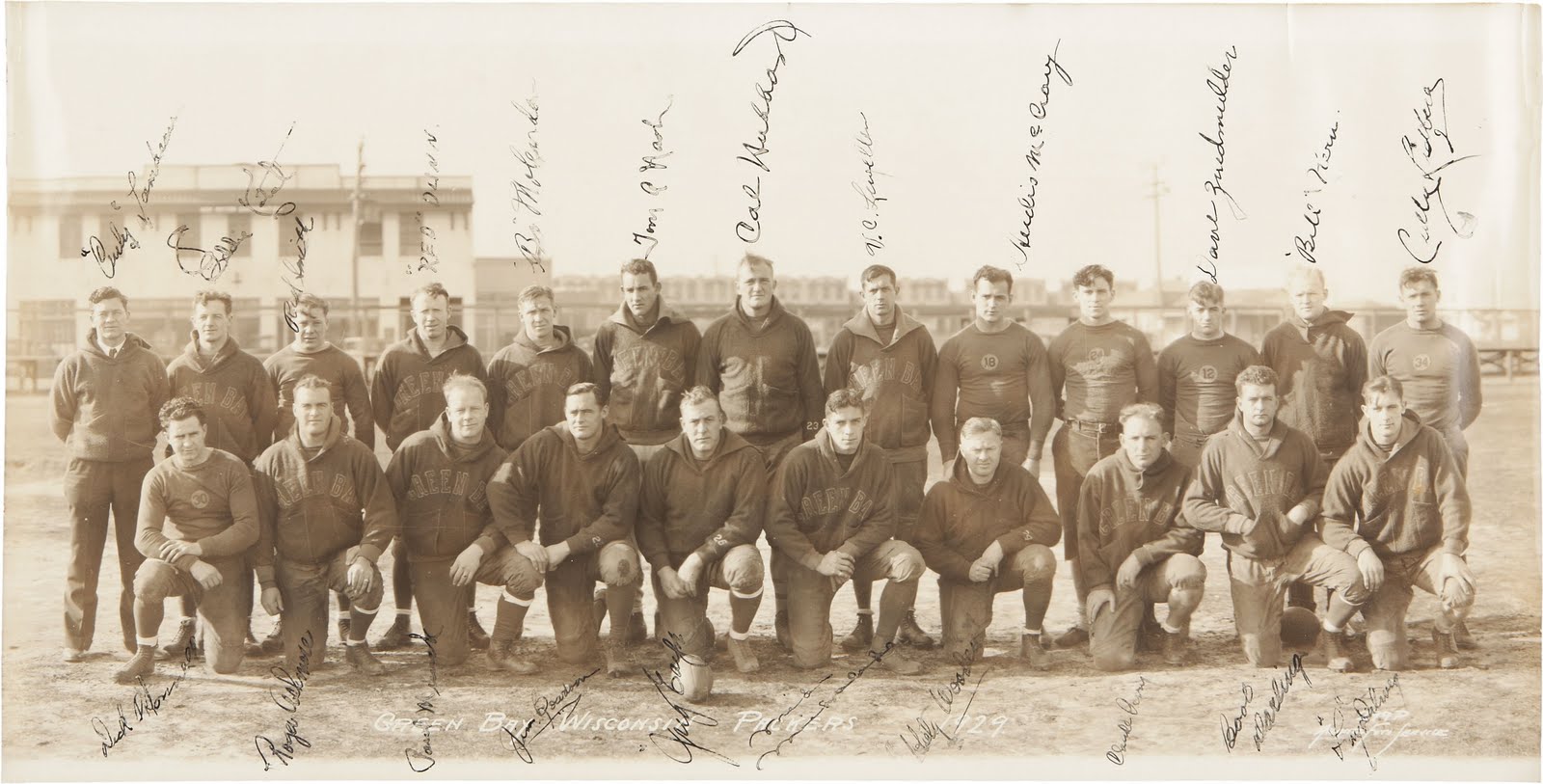
 This uniform, with its blue numbers in gold circles, was worn in 1929 and 1930 and was the inspiration for the Packers' 2010-2014 throwback alternates. In this photo, we also have exemplars of two styles of pullover sideline jackets from the period.


 Third Jersey To Be Unveiled Friday At Fan Fest


